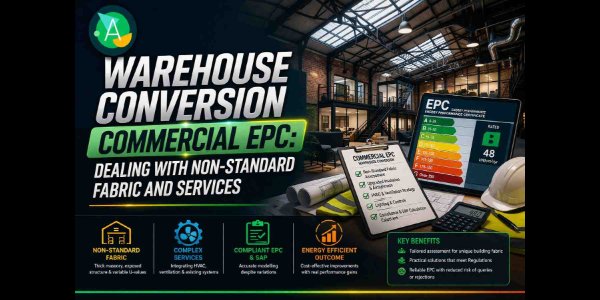
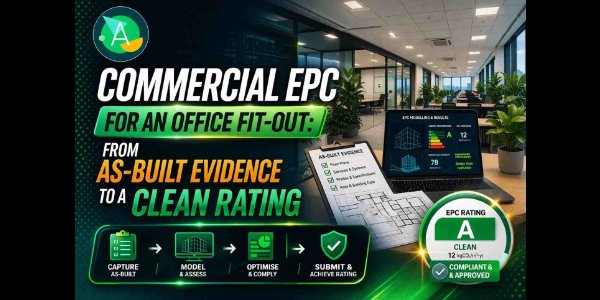
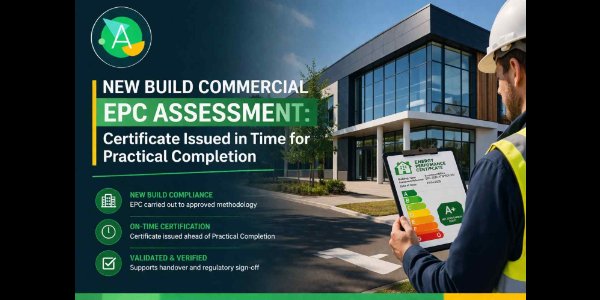
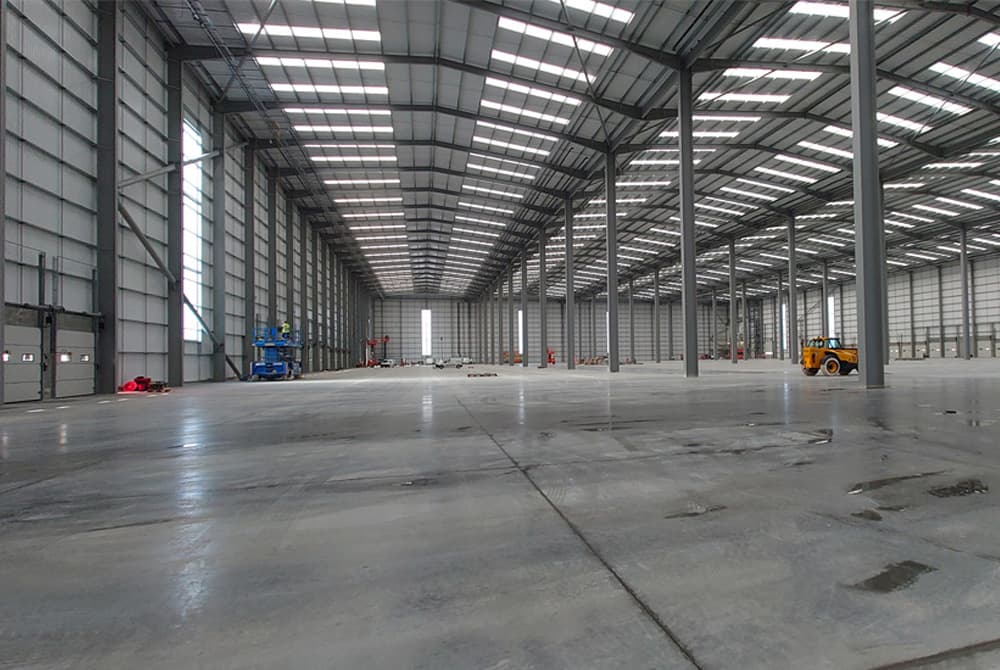
A New Build/Conversion Commercial EPC Assessment is the non-domestic EPC assessment used for a new commercial building or a commercial building created or materially modified by conversion. In practice, it is the route used for offices, retail units, industrial units, warehouses and other buildings other than dwellings when the EPC is linked to construction completion or qualifying modification, not a routine existing-premises sale or renewal EPC.
No. This service is for new-build commercial buildings and commercial buildings created or reconfigured through conversion or qualifying modification, not the ordinary EPC route for an existing office, shop, warehouse or industrial unit being re-let or sold in its existing form. If the premises is simply an existing non-domestic property on the market, that is a different EPC workflow.
The certificate format is still a non-domestic EPC, but the trigger is different. A new-build/conversion commercial EPC is tied to construction completion or qualifying modification, and it usually sits alongside the wider Part L / BRUKL process. An ordinary existing-premises EPC is typically required because the building is being sold or rented out in its existing state. That distinction matters because the information, timing and compliance context are not the same.
For this service, the key point is whether the work is creating a new building or a newly modified building that falls into the EPC-on-construction route. Official guidance says that when works are carried out to create new buildings, whether by new build or by conversion of an existing building, the person responsible for the construction must obtain an EPC once construction has been completed.
Yes, where the end result is a building other than a dwelling and the project falls into the construction or qualifying-modification route. The non-domestic EPC guide also makes clear that a modified building requires an EPC where it ends up with more or fewer parts designed for separate occupation and the modification includes the provision or extension of fixed services such as heating, air conditioning or mechanical ventilation.
Yes, often it does. The official non-domestic EPC guide says that if a building is modified so it will have more or fewer parts designed to be used separately, and the modification includes the provision or extension of fixed services for heating, hot water, air conditioning or mechanical ventilation, an EPC is required when the work is complete. That is a classic trigger on subdivision and reconfiguration jobs.
No, not normally. The official guide says that an internal refit with new heating, hot water, air conditioning or mechanical ventilation would not trigger the requirement for an EPC unless the building is also converted so as to comprise more or fewer parts for separate use. That is one of the clearest reasons this service should not be confused with ordinary existing-premises work.
Yes. This service sits firmly on the non-domestic / buildings other than dwellings side of the regime. The current Part L Volume 2 guidance in England applies only to buildings other than dwellings, and the approved methodology for non-dwelling EPCs is the National Calculation Methodology, not domestic SAP. If the end product is a dwelling, you are in the domestic EPC route instead.
The approved route is the National Calculation Methodology (NCM) for buildings other than dwellings, implemented through SBEM or an approved Dynamic Simulation Model (DSM). The 2026 England notice of approval says the energy performance of a building that is not a dwelling must be calculated using an approved implementation of the NCM, i.e. SBEM or an approved DSM, and the Welsh notice says the same for new buildings other than dwellings in Wales.
In England, the current approved methodology for expressing the energy performance of all buildings other than dwellings is the NCM for buildings other than dwellings in England, 2026 version. For practical modelling, that means an approved implementation of the NCM, such as SBEM or an approved DSM, is used for the commercial EPC and associated compliance outputs.
In Wales, the current approved methodology for new buildings other than dwellings is the National Calculation Methodology for buildings other than dwellings in Wales, 2022 version. The Welsh notice of approval says the target and calculated primary energy and emission rates, and the asset rating for the EPC-on-construction route, are calculated using SBEM version 6.1 or an approved DSM.
SBEM is the government-approved Simplified Building Energy Model route for many non-domestic buildings, while a DSM is an approved Dynamic Simulation Model used where a more detailed modelling approach is needed. Official methodology notices in England and Wales recognise both routes. In practical terms, straightforward offices, retail and industrial units often sit comfortably in SBEM, while more complex buildings may justify DSM.
No. A commercial EPC is an asset rating based on the building’s calculated energy performance, while a DEC is an operational rating based on the actual energy consumption of certain public buildings. The official DEC guide says a DEC reflects actual metered use over the previous 12 months, whereas the approved methodology notice for EPCs describes the EPC route as an asset-rating calculation.
A commercial EPC assessment uses the non-domestic NCM, i.e. SBEM or an approved DSM, while a domestic EPC for a new dwelling uses SAP. The official methodology notice draws this line clearly: dwellings use SAP or RdSAP as appropriate, while buildings that are not dwellings use the NCM for buildings other than dwellings. So if the end product is commercial, this is not a SAP job.
Yes. The official non-domestic EPC guide says that when a building being constructed is physically complete, the person carrying out the construction must give an EPC and recommendation report to the building owner and notify Building Control that this has been done. Building Control will not issue a completion certificate until satisfied this has happened.
It is the responsibility of the person carrying out the construction or modification works. The official guide says that when a new non-dwelling is completed, or when a qualifying modification creating more or fewer separately used parts is completed, that person must provide the EPC and recommendation report to the owner and notify Building Control.
Yes, in the sense that the official non-domestic EPC guide says the requirement for an EPC to be made available to a prospective buyer or tenant does not apply until construction or modification is complete. That said, once the work is physically complete, the EPC has to be provided to the owner and Building Control before completion sign-off is given.
A non-domestic EPC is normally valid for 10 years, or until a newer EPC is produced for the building sooner. The official non-dwelling EPC guide states this directly for the sale or renting out of non-dwellings. In practice, a newer certificate can supersede the earlier one if the building is reassessed later.
A commercial EPC shows the building’s energy efficiency rating on the familiar A to G scale and is intended to indicate the building’s typical energy performance in use. The official non-dwelling EPC guide says the rating is linked to running costs and is shown on an A–G scale similar to consumer appliances. It is an asset-rating certificate, not a meter-bill report.
Yes. The official non-dwelling EPC guide says the EPC includes recommendations on how to improve energy efficiency, and the construction-completion duty specifically requires the builder or modifier to give both the EPC and recommendation report to the building owner. So the service is not just a rating band; it also produces the associated recommendations output.
No. The EPC is part of the overall energy-performance package, but it is not the same thing as full Part L compliance evidence. For non-domestic new buildings, Approved Document L requires design-stage and as-built BRUKL reports, target and building primary energy and emission rates, plus supporting specification lists. The EPC matters, but it is not the only document Building Control relies on.
A BRUKL report is the Building Regulations UK Part L compliance report used to show energy-compliance evidence for a non-domestic building. Approved Document L in England says the BRUKL report should be provided to the Building Control body and to the building owner to show that the work complies with the energy-efficiency requirements, and that SBEM produces it as a standard output.
Yes. Approved Document L says two versions of the BRUKL report should be produced: the design-stage BRUKL report before works begin, and the as-built BRUKL report once the building has actually been completed. The second version captures the final target and building rates plus the as-built specification and any changes from design stage.
It should be done before works begin. Approved Document L Appendix C says the first BRUKL report is the design-stage report and is produced before works start, including the target and building primary energy and emission rates and a supporting list of specifications. In practical terms, leaving BRUKL until site has already fixed the envelope and services is asking for delay.
The final EPC should be produced when the building is physically complete and the final specification is known, because that is when the statutory handover duty bites. The official non-domestic EPC guide says the EPC and recommendation report must be given to the owner when construction or qualifying modification is physically complete, and Building Control will not issue completion until satisfied.
Yes. Approved Document L says the as-built BRUKL report must include the final specification list and identify any changes from design stage, and the software automatically produces a schedule of changes for that comparison. So late changes to glazing, HVAC, lighting, controls or envelope build-up can move both the compliance position and the final EPC output.
Yes. Because the final assessment is based on the as-built building and services, a single late substitution can change the performance inputs that feed both the BRUKL report and the EPC. Approved Document L requires the as-built BRUKL report to record the final specifications and confirm any changes from the design-stage list, which is exactly why uncontrolled substitutions cause last-minute problems.
You need enough information to define the geometry, zones, activities, services, lighting and fabric. The official non-dwelling EPC guide says the assessor will need zone dimensions, activities in each space, heating and ventilation services, lighting and controls, and fabric performance information for walls, roofs, floors and glazing. Good drawings and clear specifications save time immediately.
For new-build and conversion work, it is usually strongly plans-and-specification led, but the assessor still needs confidence that the information is accurate for what is being certified. The official guide says that dimensions and building data may be provided from plans, but if plans are not available the assessor must survey the building and gather the information. In practice, design-stage work leans on drawings; final work depends on as-built verification.
Because the model does not treat all commercial space the same. The official non-dwelling EPC guide says different activities within zones can result in different occupancy periods, temperatures, lighting and hot-water needs, and the calculation is based on those demands in relation to the building services provided. Office, retail, storage and workshop space do not behave identically in the model.
Zoning means dividing the building into spaces that have different activities, services or operating assumptions so the model reflects how the building is actually intended to function. The official guide says one of the main steps in the assessment is identifying the different zones of the building and understanding the designed purpose of each space. On complex schemes, zoning is one of the biggest drivers of both accuracy and lead time.
It depends on the building arrangement. The official guide says that where a building has a common heating system, one EPC for the whole building may often be used for any part when sold or let. Where parts have independent heating systems, it can be permissible to provide EPCs for each individual part plus the conditioned communal areas, or one EPC for the whole building. The right answer depends on the servicing arrangement and how the building is being dealt with.
Yes, sometimes. The official guide says an EPC for a single unit within a building may be based on the assessment of a similar representative unit in the same block, and where multiple assessments rely on a representative unit the assessor needs to visit a sufficient sample to verify they are genuinely representative. On repeated office or retail units, that can simplify delivery if the units really are alike.
They have to be modelled according to how they are actually served. The official guide gives examples showing that conditioned communal areas may need to be included in the whole-building EPC, while units with common heating may share a whole-building EPC route. Unconditioned communal space is treated differently. On commercial multi-unit schemes, this is one of the first scoping points to settle properly.
If the residential space is clearly designed and accessed as a separate dwelling, it should have its own domestic EPC, while the commercial part is assessed as a non-dwelling. The official non-dwelling EPC guide gives the example of a shop with a separate-access dwelling above and says the residential space should have its own domestic EPC using SAP or RdSAP as appropriate, while the non-domestic part uses SBEM or DSM.
Then it is generally treated as part of the non-dwelling, not as a separate dwelling. The official guide says that where the residential space above a shop can only be accessed via the shop and is not designed or altered for use as a separate dwelling, it should be assessed with the shop as a single building, and the SBEM route is more appropriate.
Yes, in one specific case. The official guide says that stand-alone buildings or building units that are entirely detached and have a total useful floor area of less than 50m² do not require an EPC. That is a real exemption, but it is narrow. Small units that are not detached do not automatically fall outside the regime.
Yes. The official non-dwelling EPC guide says that where building units are let as bare structures without services, but there is an expectation they will be fitted out and energy will be used to condition the indoor climate, an EPC should still be provided. Approved Document L also has dedicated shell-and-core provisions for the design-stage and as-built Part L calculations.
It is produced using reasonable assumptions about the fit-out and, for the EPC route, on the basis of the most energy intensive fit-out allowed by Part L. The non-dwelling EPC guide says that where insufficient information is supplied because the shell has no services installed, the EPC defaults to the most energy intensive fixed-services fit-out allowed under Part L. Approved Document L also requires the shell developer to state the assumed efficiencies of services not provided in the base build.
If the incoming occupier’s first fit-out provides or extends fixed services such as heating, hot water, air-conditioning or mechanical ventilation, Approved Document L says a new target and building primary energy and emission submission must be made to Building Control for the part of the building covered by that fit-out. In practice, shell and core is not the end of the energy-compliance story.
Yes, it can. Approved Document L explicitly notes that for shell-and-core developments, when relevant fit-out work takes place, a new EPC is required for the part of the physical building covered by the fit-out work. That is a key commercial point on landlord shell and tenant fit-out schemes, because the base-build EPC is not always the last certificate the project will need.
For a new non-domestic building in England, the owner should receive the as-built BRUKL report and the building log book information required by Approved Document L. That log-book information should include the inputs used in the target and building energy calculations and the recommendations report generated with the on-construction EPC. If building automation and control systems are installed, their energy-performance information should also be provided.
For a new non-domestic building in Wales, the building owner should receive the as-constructed BRUKL report and the required handover information in the building log book. The Welsh guidance also says this handover information should include the recommendations report generated with the on-construction EPC, and where building automation and control systems are installed, information about their energy performance should also be given to the owner.
Yes. In England, Approved Document L says that for new buildings over 1000m², the information handed over to the owner should include a forecast of the actual energy use of the building in kWh/year, broken down by fuel type and including all metered uses, including unregulated loads. That is an extra layer of handover information beyond the EPC and BRUKL alone.
Yes, those are all standard use cases, provided the project is new build or a conversion / qualifying modification rather than an ordinary existing-premises EPC refresh. The official non-dwelling EPC guide specifically gives examples involving office blocks, shopping centres and retail units, and industrial units, which is why those asset types sit naturally within this service.
It must be carried out by an accredited energy assessor who is a current member of an accreditation scheme and is qualified for the type of building being assessed. The official non-dwelling EPC guide says the assessment must be carried out by an accredited assessor, and that assessors must be qualified for the relevant building type. In practice, this is the non-domestic energy assessor route.
Lead time is mainly driven by information quality and building complexity. The official guide shows why: the assessor needs accurate data on zones, activities, services, lighting and fabric, and different building uses can create very different modelling demands. In practice, the biggest delays usually come from incomplete specifications, unclear zoning, shell-and-core assumptions left vague, and late design changes between the design-stage and as-built submissions.
Cost usually depends on the size, zoning complexity, number of units, servicing strategy, and whether SBEM or DSM is needed, rather than one flat fee. The official non-dwelling EPC guide makes clear that commercial buildings can involve multiple activities, different service types, communal areas and varying unit arrangements. In practice, a simple single-use unit is priced very differently from a multi-zone mixed-use or shell-and-core scheme.
Get the assessor involved early, produce the design-stage BRUKL before works begin, fix the building use assumptions early, and keep a live record of any specification changes so the as-built BRUKL and EPC do not become a last-minute reconstruction exercise. Approved Document L is built around this two-stage process, so the projects that manage it actively are the ones that avoid completion-week problems.
Treat it as a live compliance workstream, not a final-day certificate request. The strongest route is to appoint the assessor at design stage, complete the BRUKL submission before works start, keep use-class and zoning assumptions stable, track substitutions carefully, and finalise the as-built information before Building Control is waiting on it. The legal handover duty is tied to physical completion, so late EPC work almost always becomes a programme issue.
Videos for new build/conversion commericial EPC assessments
Explore our videos for quick, engaging insights on building compliance. From step-by-step guides to expert advice, our video library simplifies complex topics, making it easier for you to take action and stay informed. Perfect for when you need clarity in minutes!