
Sound insulation testing is the on-site measurement of how much sound passes through a separating wall or floor between dwellings or rooms for residential purposes. In practical terms, it tells you whether the completed partition is stopping enough airborne noise and, where relevant, impact noise to satisfy the required standard. On UK projects, this is the Part E acoustic test most developers mean when they ask for a sound test.
Yes, in most residential Building Regulations conversations, sound insulation testing, acoustic testing and a sound test usually mean the same thing. The core job is to measure airborne and, where relevant, impact sound transmission through separating elements. The important distinction is not the label, but whether the testing is being done as formal pre-completion sound testing for Part E or as an earlier diagnostic exercise.
Sound insulation testing is required because Part E is there to ensure reasonable resistance to the passage of sound between homes and similar residential spaces. Approved Document E says compliance with Requirement E1 is normally demonstrated through on-site pre-completion testing carried out as part of the construction process. In simple terms, the design may look fine on paper, but the test proves what was actually built.
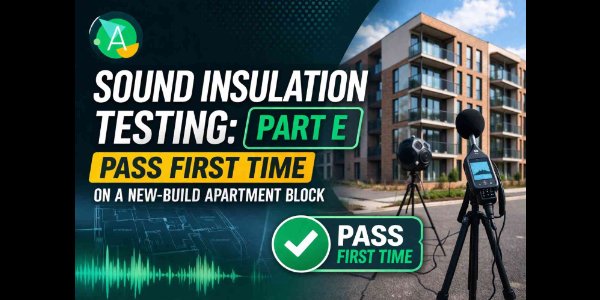
The standard testing route applies to purpose-built dwelling-houses and flats, dwellings formed by material change of use, purpose-built rooms for residential purposes, and rooms for residential purposes formed by material change of use. That means the service is relevant to new-build housing, apartment blocks, hotel-style residential accommodation, student-type residential schemes and many conversion projects.
No, not every plot is tested individually in the usual Part E route. Approved Document E uses sample testing, with one set taken on the first plots completed in each group or sub-group and then at least one further set for every ten dwellings, flats or rooms for residential purposes in that group or sub-group, assuming there are no failures. So the real issue is not every plot, but every construction group
For dwelling-houses, one set normally comprises two airborne wall tests. Approved Document E says the usual approach is one airborne test between a pair of rooms suitable for use as living rooms and another between a pair suitable for use as bedrooms, both across the separating wall. On site, that is why terraced or semi-detached house testing is usually simpler than flats.
It depends on the layout. For flats with separating floors but no separating walls, one set is normally four tests: two airborne and two impact. For flats with both a separating floor and a separating wall, one set is normally six tests: four airborne and two impact. That is why apartment schemes need more coordination, access and room selection than houses.
A group or sub-group is the way Building Control and the testing strategy organise plots with the same or similar separating construction and flanking details. Approved Document E says meaningful inferences can only be made where the construction type is the same within a group, and further sub-grouping is needed where there are significant differences in separating elements, flanking details or unfavourable features. This is why one changed wall build-up can trigger extra tests.
Yes, but only in the limited cases the scheme allows. Approved Document E and Robust Details both make clear that the Robust Details route is the alternative to routine pre-completion sound testing for new adjoined dwellings where the plots are correctly registered and built strictly to the approved detail. If those conditions are not met, the normal testing route still applies.
No. Robust Details is for new adjoined dwellings, not conversions, building refurbishments or home extensions. Robust Details says this very clearly in its guidance, which is why conversion and change-of-use projects normally still rely on proper acoustic design plus formal post-works sound insulation testing. It is a common misunderstanding on mixed project portfolios, so it is worth fixing early.
“Rooms for residential purposes” are rooms or suites of rooms that are not a dwelling-house or flat but are used by one or more people to live and sleep in, such as rooms in a hostel, hotel, boarding house, hall of residence or residential home. This matters because Part E has separate performance tables and testing logic for this category.
Sometimes, but not automatically in every case. The official Part E FAQ says there is no single answer because some HMOs contain rooms that meet the definition of rooms for residential purposes and some do not. If the HMO is being used in a way similar to a hostel, hotel, boarding house, hall of residence or residential home, testing is more likely to be relevant. Smaller shared-house arrangements may fall differently.
Student-style residential accommodation is commonly within the “rooms for residential purposes” category, so yes, it often falls within the Part E framework. Care homes are more nuanced: the official FAQ says Building Control has to decide case by case, especially where residents are receiving a high level of care and the situation is closer to hospital-style patient accommodation. That is why early classification matters.
An airborne sound insulation test measures how well a wall or floor resists sound travelling through the air, such as speech, TV or music. The tester places a loudspeaker in the source room, measures the noise generated there, and then measures what reaches the receiving room on the other side of the separating element. It is the core test used on party walls and also on floors between stacked homes.
An impact sound insulation test measures how much structure-borne noise is transmitted through a floor from direct contact, such as footsteps or banging. It uses a tapping machine on the floor above and measures the resulting sound in the room below. In practice, this is the Part E test that matters most where homes are stacked rather than just side by side.
DnT,w + Ctr is the single-number result for airborne sound insulation between rooms, and L’nT,w is the single-number result for impact sound insulation of floors. In practical terms, DnT,w + Ctr is the wall-or-floor airborne number you want to be high enough, while L’nT,w is the impact number you want to be low enough. These are the key Part E pass/fail figures in field testing.
For purpose-built dwelling-houses and flats, the usual field targets are 45 dB DnT,w + Ctr minimum for walls, 45 dB DnT,w + Ctr minimum for floors and stairs with a separating function, and 62 dB L’nT,w maximum for impact sound through floors and stairs. These are the main benchmarks developers are working to on new-build housing.
For dwelling-houses and flats formed by material change of use, the usual field targets are 43 dB DnT,w + Ctr minimum for walls, 43 dB DnT,w + Ctr minimum for floors and stairs with a separating function, and 64 dB L’nT,w maximum for impact sound. The conversion targets are slightly less demanding than purpose-built new build, but they are still easy to miss if flanking and retained fabric are not controlled.
For purpose-built rooms for residential purposes, the field targets are 43 dB DnT,w + Ctr minimum for walls and 45 dB DnT,w + Ctr / 62 dB L’nT,w for floors and stairs. For rooms for residential purposes formed by material change of use, the floor target becomes 43 dB / 64 dB. This is why correctly classifying the building type at the outset matters.
Yes. For airborne insulation, a higher DnT,w + Ctr result means more sound is being stopped between rooms. That is why the Part E tables set airborne values as minimum targets. On site, if your airborne result is only just scraping the minimum, you have very little margin for variability elsewhere on the project.
Yes. For impact sound insulation, a lower L’nT,w result is better because it means less tapping-machine noise is being measured in the receiving room. That is why the Part E tables treat impact values as maximums, not minimums. If the number climbs, the floor is performing worse, not better.
No. Approved Document E is clear that the performance values already include a built-in allowance for measurement uncertainty, so if a test misses the relevant value by any margin, it is a fail. That is a crucial point for developers and contractors: there is no informal pass zone just under the line.
Not normally as part of standard Part E field testing. SITMA explains that internal partitions within one home are not usually tested on site because there is always a doorway route for sound to travel around the wall or floor, which would distort the result. So field testing focuses on separating elements between homes or qualifying residential spaces, not normal internal room dividers.
Yes. Even though they are not normally field tested on site, internal walls and floors still have to meet the relevant laboratory performance route under Part E. Approved Document E Table 0.2 sets a minimum Rw 40 dB for new internal walls and floors within dwelling-houses, flats and rooms for residential purposes, and SITMA reflects the same basic requirement for England and Wales.
Testing is normally carried out between habitable rooms, and Approved Document E says it is preferable for each set of tests to include bedrooms and living rooms. SITMA makes the same practical point and notes that testers will often mix room types where necessary to suit the actual layout. In practice, the engineer chooses the rooms that best represent the separating element and the site risk.
No, not as a standard Part E sound insulation test. Approved Document E says testing should not be carried out between living spaces and corridors, stairwells or hallways, and the official FAQ explains that these spaces can produce unreliable results because of their geometry and the difficulty of defining their volume. If that junction is acoustically critical, it needs design review, not a standard field sound test.
It should be carried out when the rooms on either side of the separating element are essentially complete, except for decoration. Approved Document E says this explicitly and adds that impact tests should be carried out without a soft floor covering unless an allowed exception applies. In practical terms, the sweet spot is second-fix complete, quiet enough to test, and before completion pressure becomes a problem.
The plots should be complete to second fix, with windows and doors installed, internal doors fitted and closable, power available in each room, and site conditions quiet enough for valid measurements. SITMA states these points directly, and they line up with the Approved Document E requirement that the spaces be essentially complete. Poor readiness is one of the easiest ways to waste a visit and create a false fail.
Yes, especially for impact testing. Approved Document E says impact tests should normally be carried out without a soft covering such as carpet or foam-backed vinyl, because those finishes can materially improve the measured result. That is why a floor that feels quiet in use is not always the same as a floor that passes the formal Part E test in the required condition.
Yes, it can. Current ISO 16283 field methods are intended for use in both furnished and unfurnished rooms, so occupied existing properties can still be measured. The practical issue is usually access, background noise and whether the test is diagnostic or formal Part E compliance testing. On new-build compliance jobs, the test is still usually done before occupation because that gives cleaner control of the space.
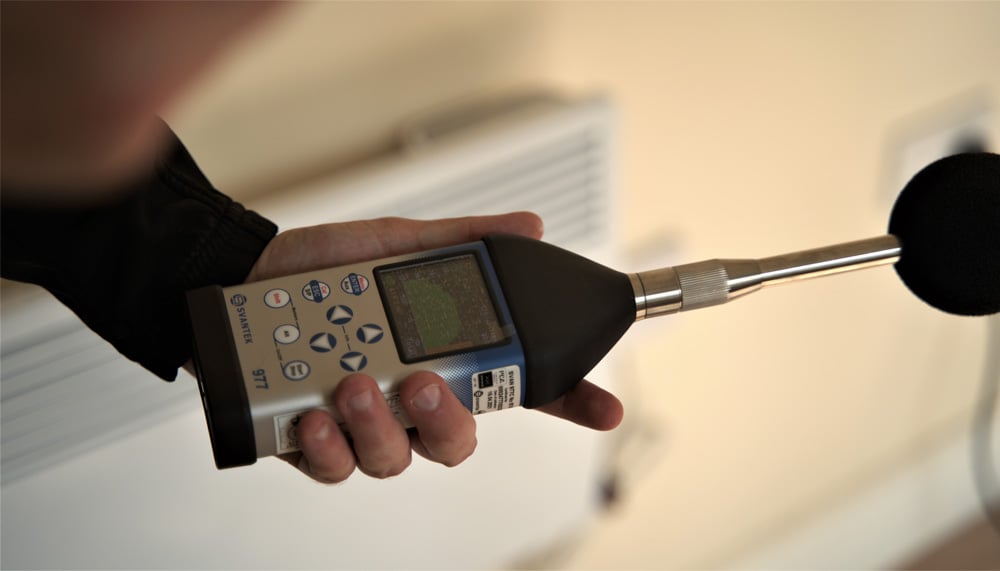
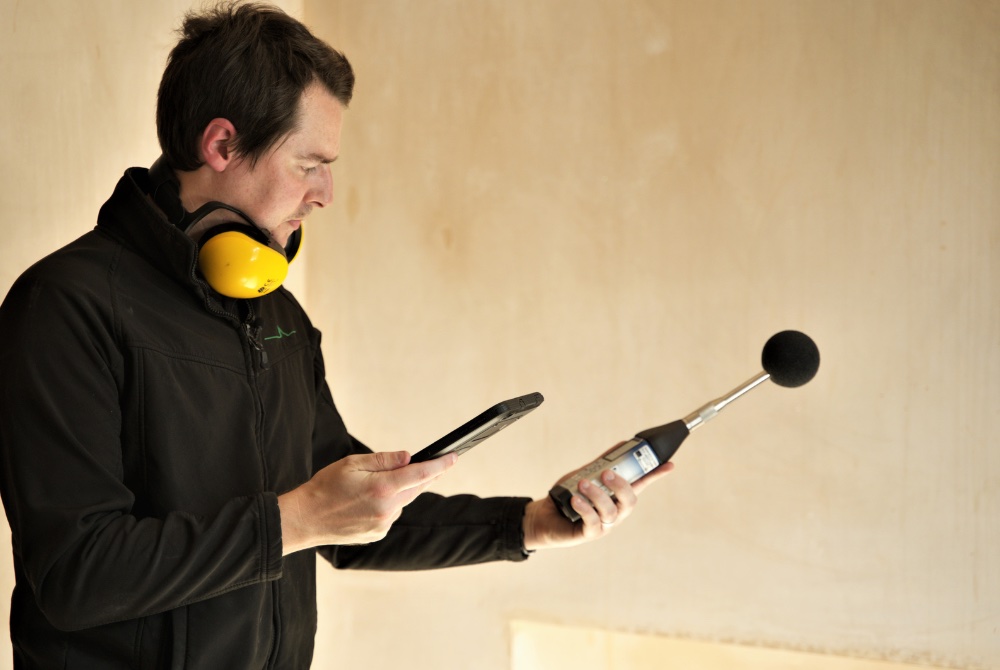
For airborne testing, the core kit is a loudspeaker, sound level meter and building acoustics software. For impact testing, the main additional item is the tapping machine, with a loudspeaker still used for reverberation measurements. SITMA lists this standard equipment clearly, and it is the basic test setup most site teams recognise when the engineer arrives.
Approved Document E Annex B still formally calls up BS EN ISO 140-4:1998, BS EN ISO 140-7:1998 and the BS EN ISO 717 rating standards for the regulatory procedure. At the same time, current field-measurement practice has moved on to the ISO 16283 series, with ISO 16283-1 current and BS EN ISO 16283-2:2020 current under review. A competent tester should understand both the regulatory basis and the current standards landscape.
The person carrying out the building work must arrange for the testing, but the actual test should be done by a specialist acoustic test body. Approved Document E says the testing should be carried out by a body with appropriate third-party accreditation. In practice, developers and contractors should be looking for a genuine acoustic testing specialist, not just the cheapest available site booking.
The guidance says the testing body should have appropriate third-party accreditation, with UKAS preferred for field measurements or a European equivalent. Approved Document E also recognises members of the ANC Registration Scheme as suitably qualified, and ANC says its current scheme independently verifies tester competence and report traceability. In practice, UKAS and ANC are the two routes most people expect to see.
It depends on the number of tests and how ready the plots are. Recent UK provider guidance says a wall-only house test may take about an hour, while party wall and party floor testing is often around two hours or more, and larger flat test sets can take longer. The real time drivers are usually access, room readiness and keeping the site quiet enough for valid readings.
Cost is mainly driven by the number of tests, the number of construction groups, the size and layout of the development, travel, access and whether repeat visits are needed. Acoustic providers are fairly consistent on this point: the price is usually built around the testing scope, not a single universal tariff. On projects with multiple plot types, the grouping strategy can change the quote noticeably.
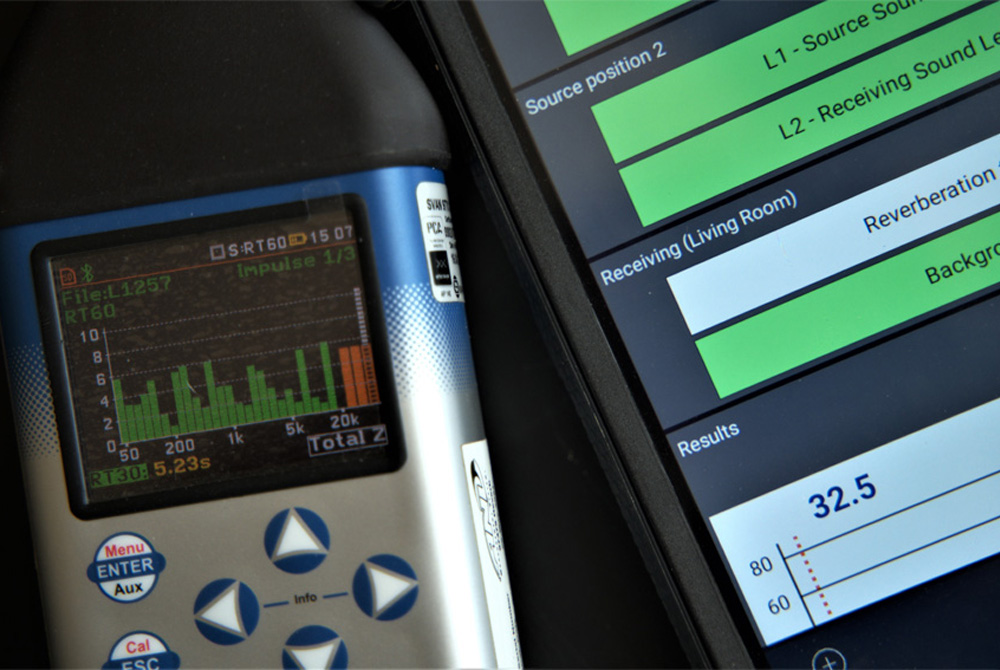
The engineer identifies the source and receiving rooms, runs the airborne and/or impact measurements, checks background noise and measures reverberation time so the results can be standardised correctly. SITMA explains the basic sequence clearly: loudspeaker tests for airborne sound, tapping machine tests for impact sound, plus the control measurements that make the results usable for compliance. On site, quiet conditions matter as much as the equipment.
There is no fixed legal turnaround from the consultant, but the market expectation is fast reporting because the result is often on the critical path for handover. Current UK provider pages commonly advertise 24–48 hour or next-working-day reporting once the test is valid and complete. What matters most is that the report is building-control ready, not just quick.
Approved Document E says the report must include the building address, property type, testing dates, testing organisation and accreditation details, rooms used, the measured single-number results, the target values, pass/fail entries, equipment details, source and receiver room volumes, and the tabular and graphical third-octave results. A proper report is far more than a one-line certificate.
The duty sits with the person carrying out the building work, who is also responsible for arranging and paying for the testing. Approved Document E says the results must be recorded in the approved manner and given to the Building Control body in line with the time limits set under the regulations. In practice, the tester provides the report, but the developer or contractor owns the compliance process.
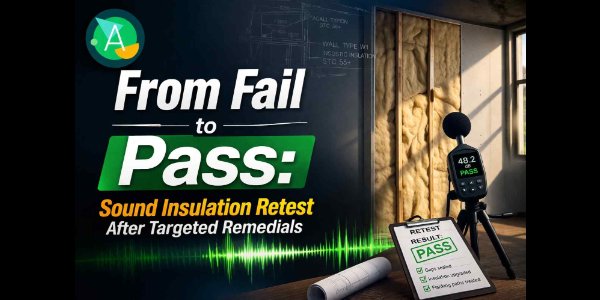
If any individual airborne or impact result in a set misses the relevant standard, the set has failed. Approved Document E says remedial treatment should then be applied to the rooms that failed, and the developer must satisfy Building Control that the issue has been addressed. That is why a failed sound test is rarely just one room’s problem.
Yes, it can. Approved Document E says a failed set raises questions about other rooms sharing the same separating element and about other untested properties that may have the same issue. Building Control can require additional testing, wider remedial works, or proof that the cause of failure does not exist elsewhere. That is exactly why acoustic failures can spread into programme delay.
Most failures come from poor workmanship, missing acoustic details and unaddressed flanking transmission rather than from the headline wall or floor spec alone. Approved Document E says the guidance must be followed properly to minimise failed tests, and ANC repeatedly highlights flanking routes, junctions and retained fabric as the practical weak points on conversions and complex sites. In short, the drawing may pass, but the build still has to.
Flanking transmission is sound travelling around the main separating wall or floor through adjoining construction rather than straight through the partition being tested. ANC’s conversion guidance gives real-world examples such as continuous ceilings, floors and hidden voids compromising an apparently good separating element. On site, flanking is one of the biggest reasons a project with a “good spec” still fails.
Yes, where the retained separating walls or floors are still intact enough to test meaningfully. ANC says sound insulation testing can sometimes be carried out before conversion work starts to determine existing performance, but where the structure is no longer intact, an inspection of the undeveloped building may be more useful instead. This is often the smartest way to reduce acoustic design guesswork on conversions.
No. Sound insulation testing measures how sound passes through the building fabric between spaces, while BS 8233 and BS 4142 are used to assess the noise environment around a site in different ways. ANC’s conversion guidance treats these as separate but related workstreams: one for the internal separating construction and one for the wider acoustic environment affecting the scheme.
No. Corridor, hallway and stair-core reverberation is a separate Part E Requirement E3 issue, not the same as the E1 sound insulation test. The official FAQ says E3 is there to protect residents from noise in reverberant common areas, and Approved Document E sets out separate sound-absorption methods for those spaces. A wall/floor pass does not automatically prove corridor absorption compliance.
Yes, but carefully. Approved Document E recognises that some properties, such as loft apartments, may be sold before being fully fitted out. It says sound insulation measurements should then be made between the available spaces following the normal principles, and steps should be taken to ensure later fit-out does not adversely affect the sound insulation. This is one of those details worth agreeing early, not late.
Yes, sometimes. Approved Document E says that in some historic buildings undergoing material change of use, it may not be practical to reach the standard values in full. In those cases, the aim is to improve sound insulation as far as is practical without harming the building’s character or long-term condition, and the achieved tested values may then need to be displayed inside the building.
Book early, group the plots properly, get the acoustic design right before site locks the details in, control flanking routes, and only test when the plots are genuinely ready. ANC says the best way to maximise the chance of passing is to seek expert guidance before construction starts, and Approved Document E says specialist advice should be sought early where extra guidance is needed. The projects that pass first time usually treat acoustics as a package, not a late certificate.
Videos for sound insulation testing
Explore our videos for quick, engaging insights on building compliance. From step-by-step guides to expert advice, our video library simplifies complex topics, making it easier for you to take action and stay informed. Perfect for when you need clarity in minutes!