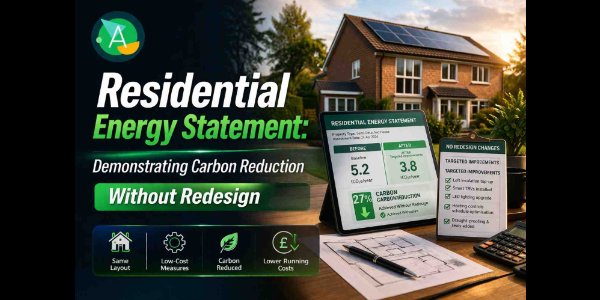
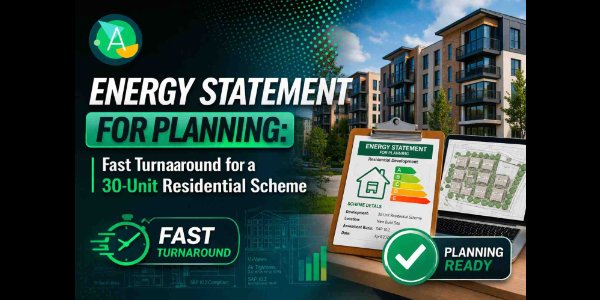
An Energy Statement is a planning-stage report that explains how a proposed development will reduce energy demand and carbon emissions in line with the relevant planning policies. In practical terms, it shows the local planning authority how the scheme is expected to perform, what measures are being used to cut emissions, and how the project responds to the relevant policy framework before planning permission is determined. (london.gov.uk , cityoflondon.gov.uk)
Usually, yes. In UK planning language, “Energy Statement” and “Energy Strategy” are commonly used to mean the same supporting planning document. Official London guidance talks about an energy assessment and a detailed energy strategy, while local authorities often label the submitted document an Energy Statement. In practice, the planning officer is looking for the same thing: a clear report showing the carbon and energy approach for the scheme. (london.gov.uk , westminster.gov.uk)
Not necessarily. Some authorities keep them separate. The City of London, for example, asks for a Sustainability Statement and says the summary of the energy approach should sit there, with the detail in a separate Energy Statement. On real projects, the two documents often overlap, but they are not automatically interchangeable unless the local authority’s validation guidance says they can be combined. (cityoflondon.gov.uk)
No. There is not one blanket national rule saying every planning application in England or Wales must include an Energy Statement. In practice, the requirement usually comes from local planning policy and the local validation list. That is why some councils require them for all major schemes, while others also ask for them on specific minor developments. (broxtowe.gov.uk , westmorlandandfurness.gov.uk , westminster.gov.uk)
In England, the NPPF says major development means 10 or more homes, or a site of 0.5 hectares or more where the number of homes is unknown. For non-residential development, it means 1,000m² or more of additional floorspace, or a site of 1 hectare or more. That definition matters because many Energy Statement requirements, especially in London and in local validation lists, are triggered at the “major” threshold. (assets.publishing.service.gov.uk)
Yes, in practical planning terms they do. The GLA says an energy assessment is required for all major planning applications, and London Plan Policy SI 2 says major development proposals should include a detailed energy strategy showing how the zero-carbon target will be met through the energy hierarchy. That is why a London major application without a proper Energy Statement is usually heading straight for validation or officer-query problems. (london.gov.uk , london.gov.uk)
Yes. Minor schemes can still need one where the local authority requires it. Haringey says applicants must submit an Energy Statement for minor applications creating 1 to 9 new dwellings or under 1,000m² of new non-residential floorspace, and Merton now has a dedicated minor residential energy assessment template in its planning guidance. So minor does not automatically mean “no energy statement”. (haringey.gov.uk , merton.gov.uk)
Yes, often they do, especially in London and on major applications. The London Plan requires major development to submit a detailed energy strategy, and local authority guidance such as Haringey’s minor-energy guidance also covers new residential dwellings. In practice, residential Energy Statements usually rely on SAP-based outputs for the domestic parts of the scheme and then explain how the design achieves the required carbon reductions. (london.gov.uk , haringey.gov.uk)
Yes, often they do. Energy Statements are not just for housing. The NPPF major-development threshold includes non-residential floorspace of 1,000m² or more, and local authorities such as Westminster, Westmorland & Furness and Haringey require Energy Statements for major commercial schemes, with Haringey also applying its minor-energy guidance to under 1,000m² of new non-residential floorspace. (assets.publishing.service.gov.uk , westminster.gov.uk , haringey.gov.uk)
Yes. Mixed-use schemes are one of the most common reasons Energy Statements become technically detailed, because the document often has to explain the energy approach for both domestic and non-domestic parts of the proposal. In London, the GLA guidance expects the energy assessment to demonstrate policy compliance across the development, and mixed-use schemes often need both residential and non-residential modelling streams inside the same statement. (london.gov.uk , cityoflondon.gov.uk)
Yes, very often. Haringey’s guidance explicitly says its minor Energy Statement requirement includes new buildings and extensions that result in new floorspace, and local planning practice commonly applies Energy Statements to conversion and change-of-use schemes where new dwellings or new commercial floorspace are being created. On real projects, conversions are often the schemes where the energy strategy needs the clearest explanation because the retained fabric can constrain the obvious solutions. (haringey.gov.uk , westminster.gov.uk)
They usually respond to a mix of local plan policy, validation requirements, and, in London, the London Plan climate policies. Westminster, for example, requires major-development Energy Statements to demonstrate compliance with its own City Plan Policy 40 and with London Plan policies including SI2, SI3 and SI4. Nationally, the NPPF also frames climate mitigation and the move to a low-carbon economy as part of sustainable development. (westminster.gov.uk , assets.publishing.service.gov.uk)
The London energy hierarchy is Be Lean, Be Clean, Be Green, Be Seen. London Plan Policy SI 2 defines those steps as: use less energy, exploit local energy resources and supply efficiently, maximise on-site renewable energy, and monitor and report actual energy performance. In practice, a London Energy Statement is expected to show the carbon savings achieved at each stage, not just throw a renewable technology onto the roof at the end. (london.gov.uk)
For London major development, it means the scheme should be net zero-carbon in operation. The London Plan says major development should be net zero-carbon and the GLA guidance explains that the energy assessment must show how this is achieved through the energy hierarchy. In practical terms, the statement must prove the maximum on-site reduction first and then deal properly with any remaining shortfall. (london.gov.uk , london.gov.uk)
In London major development, it means the scheme must achieve a minimum on-site reduction of at least 35% beyond Building Regulations. Policy SI 2 also says residential development should achieve 10% through energy efficiency measures and non-residential development should achieve 15% through energy efficiency measures within that hierarchy. This is one of the core numbers most London planning officers look for first. (london.gov.uk)
In London, the shortfall is normally dealt with through carbon offsetting. The London Plan says that where it is clearly demonstrated the zero-carbon target cannot be fully achieved on site, the residual shortfall should be made up by an agreed route, and the GLA monitoring page says the remaining emissions are typically offset through a cash-in-lieu contribution to the borough’s carbon offset fund. (london.gov.uk , london.gov.uk)
Yes, especially in London. Policy SI 3 says boroughs and developers should engage early on energy infrastructure requirements, and Energy Statements should show whether the scheme can connect to existing or planned networks or create a suitable low-carbon communal heating solution. On larger schemes, that heat-network question often becomes one of the main planning issues, not a footnote. (london.gov.uk)
Then the Energy Statement needs to address that directly. London Plan SI 3 says major development in Heat Network Priority Areas should have a communal low-temperature heating system, and the heating hierarchy there prioritises connection to existing or planned heat networks first, then zero-emission or local secondary heat sources. If direct connection is not yet possible, the design should usually allow for future connection. (london.gov.uk)
Yes, often they do, but not always as the only document. London Plan SI 2 expects dynamic overheating modelling results and mitigation actions to be addressed in the energy strategy, while authorities such as Haringey also require a separate overheating assessment for major applications. In practice, the Energy Statement and overheating submission should line up, even if they are lodged as separate reports. (london.gov.uk , haringey.gov.uk)
No. They are related, but not the same thing. The GLA’s Energy Assessment Guidance says referable planning applications also have a requirement to calculate and reduce whole life-cycle carbon emissions, but it treats that as a separate guidance stream from the energy assessment itself. In practical terms, an Energy Statement focuses on operational energy and carbon strategy; whole life carbon reaches further into embodied impacts. (london.gov.uk)
No. They usually sit on top of those calculations rather than replacing them. Haringey’s guidance for minor developments expressly requires SAP/BRUKL output sheets to be submitted alongside the Energy Statement, and the GLA guidance expects the energy assessment to demonstrate compliance using the appropriate modelling. In simple terms, the Energy Statement is the planning narrative and strategy document; SAP, SBEM and BRUKL are part of the technical evidence underneath it. (haringey.gov.uk , london.gov.uk)
You use SAP for the domestic dwelling elements of a scheme. The approved methodology notice for England says the energy performance of new dwellings uses SAP, and Wales continues on its own SAP 10-based route. So if an Energy Statement covers new houses, flats or the residential parts of a mixed-use scheme, SAP outputs will usually form the residential modelling side of the statement. (gov.uk , gov.wales)
You use SBEM or an approved DSM for the non-domestic parts of the proposal. The current approved methodology notices for England and Wales say buildings other than dwellings are assessed through the National Calculation Methodology, implemented by SBEM or an approved DSM. So offices, retail, industrial, leisure and similar non-domestic areas in an Energy Statement usually sit in SBEM or DSM, not SAP. (gov.uk , gov.wales)
Usually, yes. Mixed-use schemes often need SAP for the residential elements and SBEM or DSM for the non-domestic elements. That is why mixed-use Energy Statements often take longer to assemble than single-use schemes: the planning document is one report, but the underlying modelling is split across two different approved calculation routes. (gov.uk , haringey.gov.uk)
At a minimum, it should include the scheme’s energy demand, proposed energy-efficiency measures, any low and zero carbon technologies, and where relevant the carbon offsetting strategy. The City of London says the energy strategy must include a comprehensive assessment of energy demand, energy-efficiency measures, low/zero carbon technologies and offsetting proposals, and Haringey’s guidance also expects supporting outputs and carbon reporting in the GLA format. (cityoflondon.gov.uk , haringey.gov.uk)
That depends on the live policy and local guidance the application is responding to. In London borough guidance such as Haringey’s, the baseline is still expressed against the Part L 2021 Building Regulations baseline, while the new England Future Homes and Buildings standards published on 24 March 2026 do not generally come into force until 24 March 2027. In practice, you should always model against the current adopted planning-policy baseline, not assume the authority has already updated everything. (haringey.gov.uk , gov.uk)
That depends on the authority, but typical supporting evidence includes SAP outputs, BRUKL outputs, and in London often the GLA carbon emissions reporting spreadsheet. Haringey’s minor-development guidance says Energy Statements must include the GLA spreadsheet and SAP/BRUKL output sheets. On larger schemes, related documents such as overheating reports, whole life carbon assessments or sustainability statements may sit alongside the Energy Statement too. (haringey.gov.uk , haringey.gov.uk)
Yes. Shell-and-core schemes still need an energy strategy at planning stage, because the authority needs to understand how the base build will meet policy and what assumptions sit behind the energy performance. City of London guidance also treats large new development and refurbishment proposals as requiring a proper energy strategy, and London Plan policy expects the zero-carbon route to be addressed within the energy hierarchy even where later fit-out stages will follow. (cityoflondon.gov.uk , london.gov.uk)
The Energy Statement at planning stage still matters, but later fit-out can reopen the energy-compliance picture. London energy policy expects the planning-stage strategy to explain how the development will meet policy, while the building-regulations side of the process for shell-and-core and later fit-out can require updated calculations and further EPC work. On real projects, that means the planning Energy Statement should set out the landlord assumptions clearly so the fit-out stage does not turn into a compliance argument later. (cityoflondon.gov.uk , assets.publishing.service.gov.uk)
Yes, often it can, but it needs to present the phases clearly. The GLA’s Energy Assessment Guidance says hybrid applications should typically provide one strategy for the entire site, while presenting the design and expected carbon performance for the detailed and outline parts separately. In practice, a phased scheme can sit under one Energy Statement, but only if the phasing logic and assumptions are transparent. (london.gov.uk)
It should be prepared before the planning application is submitted, while the design can still respond to the findings. GLA guidance says the purpose of the energy assessment is to ensure energy remains an integral part of the development’s design and evolution, and local validation pages use the Energy Statement as part of the planning submission package. If it is only commissioned once the application is nearly ready to press “submit”, the design flexibility is usually gone. (london.gov.uk , westminster.gov.uk)
Yes, very often. GLA guidance says the energy assessment is there to keep energy integrated into the design and evolution of the development, and local authorities such as Haringey say the guidance is intended to help applicants address issues early in the planning process, helping to avoid delays. On complex jobs, early energy work is usually cheaper than redesigning a planning submission after officer feedback. (london.gov.uk , haringey.gov.uk)
Yes. On some schemes, it has to be. Haringey has a dedicated guidance note for applicants discharging Section 106 energy plan and sustainability review obligations on major applications, which shows that the energy strategy can remain a live planning workstream after permission is granted. In practical terms, the planning Energy Statement is often the start of the conversation, not always the end of it. (haringey.gov.uk)
Usually a building-compliance or energy consultant writes it, but the important point is competence rather than job title. The GLA guidance says it is intended for developers, energy consultants and local government officials, and local policy often expects the document to be backed by proper SAP, BRUKL, SBEM or DSM evidence. On a live scheme, the best Energy Statement author is the person who can model the building and explain the planning policy implications clearly. (london.gov.uk)
They need enough information to understand the geometry, use, fabric, servicing strategy and low-carbon measures. Haringey’s guide expects SAP/BRUKL outputs and carbon reporting, while the City of London expects a comprehensive assessment of energy demand, efficiency measures and low/zero carbon technologies. In practice, the cleaner the drawings, specifications and plant assumptions, the cleaner the Energy Statement. (haringey.gov.uk , cityoflondon.gov.uk)
Yes, a lot. Energy Statements are only as reliable as the scheme they describe. If the façade, glazing ratio, plant strategy, heat source or renewable provision changes after the statement is finished, the carbon case can shift quickly. That is exactly why GLA guidance frames the energy assessment as something that should remain integral to the development’s design and evolution, not as a one-off admin document. (london.gov.uk)
Not in one identical way everywhere, but in practice most Energy Statements need to address on-site renewable or low-carbon generation. London Plan SI 2 includes Be Green as a core stage of the energy hierarchy, and local guidance such as Haringey’s says new developments must achieve at least a 20% reduction in emissions from on-site renewable energy generation under its policy approach. Outside London, the exact requirement depends on local policy. (london.gov.uk , haringey.gov.uk)
Yes, often it can, but the policy context matters. London Plan SI 3 says that in Heat Network Priority Areas, connection to heat networks comes first, but it also allows zero-emission or local secondary heat sources, often alongside heat pumps, within the heating hierarchy. Outside those circumstances, a well-modelled all-electric strategy can be perfectly viable if it meets the local planning and Building Regulations baseline properly. (london.gov.uk)
In London, yes, it often is. The GLA monitoring page says that where the net zero-carbon target cannot be fully met on site, the residual emissions are offset through a borough carbon-offset fund, and the City of London says offsetting proposals should be included where relevant targets cannot be met on site. So offsetting is not the first move, but it is often part of the planning-stage energy story. (london.gov.uk , cityoflondon.gov.uk)
Yes. In London, carbon shortfalls are often linked to offset contributions, and some boroughs also use Section 106 energy-plan review clauses or post-permission sustainability reviews on major schemes. Haringey has a specific guidance note for discharging Section 106 energy plan obligations, which shows how the planning-stage Energy Statement can carry through into later obligations and reviews. (london.gov.uk , haringey.gov.uk)
The usual problems are simple: wrong policy baseline, missing supporting calculations, no clear Be Lean/Clean/Green breakdown, no GLA reporting spreadsheet where one is required, and mismatches between the statement and the drawings. Haringey’s guidance is useful here because it spells out the expected submission components clearly. In practice, most invalid or weak statements fail because they are incomplete, not because the concept is impossible. (haringey.gov.uk , haringey.gov.uk)
Because the Energy Statement is often testing a moving target: design development, changing plant strategy, officer concerns about overheating or heat networks, or simple gaps in the modelling narrative. GLA guidance treats the energy assessment as something that should remain integral to the design’s evolution, and local authorities may also need post-submission clarification to check compliance with local policy and the energy hierarchy. (london.gov.uk , westminster.gov.uk)
Yes. A strong Energy Statement helps by dealing with energy, carbon and policy issues early, before they turn into validation problems, officer queries or committee concerns. Haringey’s own guidance says the purpose of its minor-energy process is to ensure relevant issues are addressed early and help avoid delays, and the GLA guidance is designed to keep energy integrated into the design process from the start. (haringey.gov.uk , london.gov.uk)
No. An Energy Statement is a planning submission document explaining how the proposed development will meet planning energy and carbon policy. An EPC is a separate energy-performance certificate required under the building/EPC regime. On real projects the two are related, but they sit at different stages and answer different questions. The planning document helps win permission; the EPC belongs to the later compliance and completion side of the project. (cityoflondon.gov.uk , gov.uk)
Yes, if it is prepared properly. The Energy Statement is usually the planning-stage wrapper around the same core energy assumptions that later feed into SAP, SBEM, BRUKL and ultimately the EPC route. Haringey’s guidance already expects SAP/BRUKL outputs with the statement, which shows how closely connected these workstreams are. A poor planning energy strategy often comes back later as a compliance headache. (haringey.gov.uk , assets.publishing.service.gov.uk)
There is no single national timeframe because it depends on the size and complexity of the scheme and on how complete the information is. A straightforward small scheme with a settled specification is far quicker than a phased mixed-use development with multiple uses, heat-network questions and overheating coordination. In practice, lead time is usually driven more by the quality of the inputs than by the writing of the report itself. (london.gov.uk , cityoflondon.gov.uk)
Cost is mainly driven by scheme complexity, not just floor area. Mixed-use developments, shell-and-core projects, hybrid applications, heat-network sites and borough-specific minor-scheme templates all create extra work. The more modelling streams, policy layers and revisions involved, the more time the consultant has to spend. On real projects, the cheapest Energy Statement can easily become the most expensive if it leads to redesign or planning delay. (london.gov.uk , haringey.gov.uk)
Yes, significantly. Outside London there is no single national Energy Statement template, so requirements can vary a lot between authorities. Westmorland & Furness requires Energy Statements for all major applications, while local-validation and climate-planning approaches differ elsewhere. In practice, that means you should never assume the submission standard from one council will satisfy the next council without checking the live local validation list. (westmorlandandfurness.gov.uk , broxtowe.gov.uk)
Sometimes, yes, but this is a policy-sensitive area. The 13 December 2023 WMS says government does not expect plan-makers in England to set local energy-efficiency standards beyond current or planned Building Regulations unless they have a robust rationale. At the same time, adopted local policies in London and some other authorities still require detailed planning-stage energy strategies. In practical terms, you need to check the live local plan and validation list rather than assume Part L alone will satisfy planning. (parliament.uk , westminster.gov.uk , london.gov.uk)
Treat it as a design tool, not just a validation document. Start early, fix the policy baseline before modelling, coordinate SAP/SBEM/BRUKL inputs with the architect and M&E designer, and keep the overheating, heat-network and renewable strategy aligned with the planning narrative. The strongest Energy Statements are the ones that explain a settled design clearly, not the ones written at the last minute to rescue an application pack. (london.gov.uk , haringey.gov.uk)
Videos for energy statements
Explore our videos for quick, engaging insights on building compliance. From step-by-step guides to expert advice, our video library simplifies complex topics, making it easier for you to take action and stay informed. Perfect for when you need clarity in minutes!