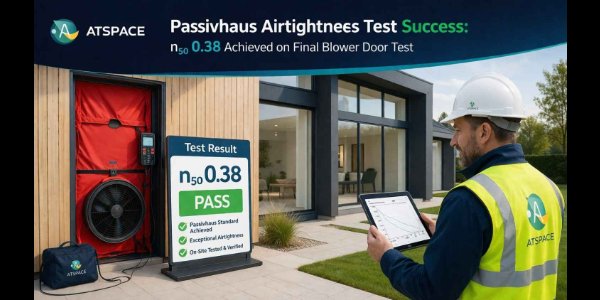

Passive House air leakage testing is a blower door pressure test used to prove how airtight a building really is for Passivhaus certification. The result is reported as n50, which is the number of air changes per hour at a pressure difference of 50 pascals. In practical terms, it tells the project team and certifier whether the built envelope is tight enough to meet the standard, not just whether the design drawings looked good on paper.
Yes. Passive House air leakage testing uses the same core fan pressurisation method that most people call a blower door test. The difference is not the fan itself, but the standard, the reporting and the level of scrutiny. A Passivhaus test has to follow the right procedure, use the correct reference volume, and produce results the certifier can rely on for certification.
Yes. “Passive House” and “Passivhaus” refer to the same building standard developed by the Passive House Institute. In the UK, Passivhaus is usually the preferred spelling because it better reflects the original standard and helps avoid confusion with broader ideas like passive solar design or passive ventilation. For SEO, it is worth targeting both spellings, but technically they mean the same thing here.
Airtightness testing is critical in Passivhaus because the standard depends on very low uncontrolled air leakage. If the envelope leaks, heating demand rises, comfort drops, draughts appear, and moisture risk increases around weak junctions. The airtightness test is one of the clearest quality checks in the whole process because it shows whether the design intent was actually delivered on site.
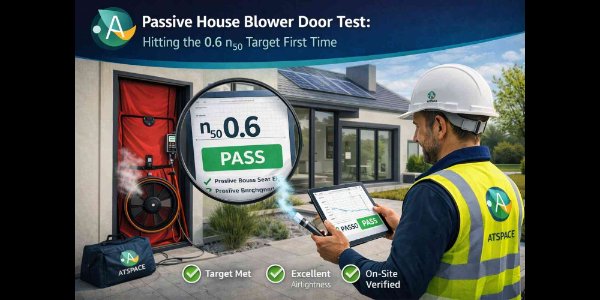
The headline Passivhaus airtightness target is n50 ≤ 0.6 air changes per hour at 50Pa. That is the threshold for Passivhaus Classic, Plus and Premium. It is a hard quality benchmark, not a vague aspiration, which is why Passivhaus projects typically plan preliminary tests, tighter site checks and more detailed airtightness coordination than standard compliance-only jobs.
Yes, much stricter. Passivhaus uses n50, based on heated internal volume, while Part L in the UK uses air permeability in m³/(h·m²) at 50Pa, so the numbers are not directly comparable. Even so, Part L’s limiting standard is far looser than Passivhaus. In practice, a building can be perfectly legal under Part L and still be nowhere near good enough for Passivhaus certification.
n50 means the number of times the air inside the heated envelope would be replaced in one hour when the building is tested at 50 pascals. It is a volumetric airtightness metric, so it reflects the relationship between leakage airflow and the building’s test volume. Lower is better. On a Passivhaus job, that single figure becomes one of the most watched numbers on the whole project.
n50 is based on the heated internal air volume, while q50 or UK air permeability is based on the area of the building envelope. That is why Passivhaus teams talk about air changes per hour, while Part L teams usually talk about m³/(h·m²) at 50Pa. The same test data can often produce both numbers, but only if the volume and envelope area have been calculated properly.
Yes, often it can. A properly planned final test can usually generate both the Passivhaus n50 result and the UK Building Regulations q50/air permeability result from the same visit, provided the building is essentially complete and the required calculations are available. That is the efficient route on UK projects, but it only works if the tester understands both standards from the start.
Yes, on most UK projects you effectively do. Passivhaus certification needs the airtightness result in n50, while Building Regulations compliance is usually judged using air permeability under Part L. The smart move is to plan one certifier-ready test strategy that satisfies both, rather than treating Passivhaus and Part L as separate last-minute exercises.
Yes. A final airtightness test is part of the evidence required for Passivhaus certification. Passivhaus Trust guidance is clear that compliance tests are required on completion, and its airtightness guidance also notes that Passivhaus expects testing across all builds, including refurbishment projects aiming for certification. On a real project, the final test is not optional admin; it is part of sign-off.
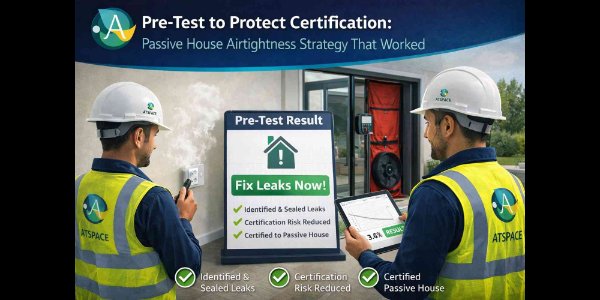
Yes, strongly. Preliminary tests are one of the best ways to protect a Passivhaus project from a late failure. Passivhaus Trust guidance says final compliance testing should generally be backed up by one or more preliminary tests, because once dry-lining, services and finishes are in, many leaks are far harder and costlier to fix. Pre-tests are where first-time pass rates are really won.
Book it as soon as the certifier route, airtightness target and likely programme are clear. Passivhaus testing is not just a final visit; it usually needs at least one preliminary check, a final certification test and time for any remedials. Late booking squeezes that breathing space out of the programme and turns a quality-control exercise into a handover risk.
The first preliminary test should usually be done once the airtight layer is substantially complete but still accessible. That is the sweet spot where the fan test can expose real leakage paths while the site team can still fix them cleanly. If you wait until the building looks finished, you lose much of the value of the exercise and turn small defects into messy remedials.
The final Passivhaus air test should be carried out at completion, or very close to it, when the building reflects its normal finished condition. That final result is the one used for certification evidence. By that stage, windows, doors, services and permanent airtightness details need to be in place, because the certifier is checking the building you are actually handing over, not an idealised earlier version.
There is no single fixed duration. A compact dwelling can be relatively quick, but Passivhaus tests often take longer than a basic compliance-only visit because they require both pressurisation and depressurisation, Passivhaus-specific reporting, and often some level of leak checking or discussion with the site team. Simple projects are fast; complex or large-volume projects need more time and more control.
There is no fixed national rate for Passivhaus air leakage testing. In practice, it is usually quoted individually because the scope varies: preliminary tests, final certification testing, Vn50 calculations, large-building qE50 reporting, diagnostics and travel all change the job. The real cost risk on Passivhaus projects is rarely the test itself; it is late failures, rework and retesting when airtightness has not been managed properly.
Yes. Passivhaus testing generally requires both negative pressure and positive pressure measurements. That is one of the clear differences from a lot of standard UK compliance conversations, where people only focus on “doing an air test” in a generic sense. For Passivhaus certification, both directions improve confidence in the result and are part of the expected method.
Yes. The Passivhaus airtightness result is normally taken as the average of the pressurisation and depressurisation results. That matters because a big gap between the two directions can point to testing issues, wind effects or a weak detail behaving differently under positive and negative pressure. A clean, believable average is what the certifier wants to see.
The core test basis is ISO 9972, Method 1, with Passivhaus-specific clarifications and additions layered on top. In the UK, final certification evidence is commonly produced in line with ATTMA TSL4, which gives a consistent route for Passivhaus and other low-energy buildings. The important point is that “ordinary air test experience” is not the same thing as following the right Passivhaus method.
ATTMA TSL4 is the UK technical standard used for air tightness testing of Passivhaus and other low-energy buildings. It is based on ISO 9972:2015 and provides the detailed testing framework that UK testers follow for this type of work. If a project is aiming for Passivhaus certification in the UK, TSL4 is the standard most teams expect the tester to understand and work to.
A Passivhaus air leakage test should be carried out by a competent airtightness tester who can work to ISO 9972 / ATTMA TSL4 and produce a certifier-ready report. For Building Regulations evidence, the government guidance also expects the tester to have appropriate training and be registered for the relevant class of building. On Passivhaus jobs, competence on paper is only the starting point; low-energy project experience matters just as much.
Yes. Passivhaus testing is not just “a normal air test with a tighter target”. The tester needs to understand Vn50, dual-direction testing, large-building qE50 reporting, temporary sealing rules and the level of documentation a certifier will expect. A tester who only thinks in basic Part L terms can still produce a result, but not always one that survives Passivhaus certification scrutiny.
Vn50 is calculated as the air volume within the heated building envelope that is actually being heated or cooled. It should be worked out room by room, following the PHI criteria, rather than guessed from a simple gross internal volume. That detail matters because the airtightness result is divided by this volume, so a sloppy Vn50 calculation can distort the headline n50 figure.
No, not automatically. PHPP contains different reference volumes for different purposes, and the blower door test uses the specific Vn50 reference volume for airtightness. Teams sometimes blur these numbers together, especially on bigger or more complex projects, but the certifier will expect the dedicated test volume to be calculated correctly rather than lifted from a rough model assumption.
If the test volume is wrong, the n50 result is wrong. That can make a building look tighter or leakier than it really is and can create unnecessary arguments with the certifier later. On a Passivhaus project, this is not a minor admin detail. If the denominator is wrong, the flagship airtightness result is wrong as well, which is why room-by-room volume work needs to be taken seriously.
qE50 is the airtightness value referenced to the building envelope area rather than the internal volume. It becomes important on larger buildings because n50 on its own gets less meaningful as the area-to-volume ratio improves. On Passivhaus projects, qE50 is therefore used as an additional check on large buildings, especially where a simple volume-based number could otherwise flatter performance.
Yes. For buildings with Vn50 ≥ 1500m³, both n50 and qE50 should be reported. That is a key point on schools, offices and other bigger projects. Passivhaus Trust guidance also flags that large buildings need more careful airtightness planning and early certifier discussion because the geometry and testing strategy can become more demanding than on a straightforward house.
Yes. Passivhaus is not just a housing standard. PHI states that the standard can be achieved in residential and most non-residential buildings, including offices, schools and even more specialist uses. The testing approach is still blower door based, but the planning, fan setup, qE50 reporting and airtightness strategy usually need more coordination on non-domestic projects than on a single dwelling.
Yes. Flats and apartment buildings can be Passivhaus certified and tested, but the pressure boundary has to be agreed properly. On multi-unit projects, the key question is what exactly forms the heated airtight envelope for the part being certified. If that is not nailed down early, testing day becomes a boundary dispute instead of a clean quality check.
They need to be handled explicitly, not assumed away. In UK Building Regulations, heated common areas and non-dwelling parts of a mixed-use building follow the non-domestic route, not the dwelling route. Passivhaus testing has to respect those boundaries too. If residential units and commercial or communal areas are thermally and airtightness-separated, they may need separate testing and separate compliance thinking.
Yes, but only with very clear boundaries and early certifier agreement. PHI is developing a dedicated Core & Shell certification track for certain non-residential buildings, which shows how important the testing boundary and tenant fit-out assumptions are on these jobs. If the envelope, services scope and future fit-out line are not defined early, airtightness testing becomes messy very quickly.
Yes. EnerPHit is PHI’s retrofit standard, and airtightness testing is part of that quality-assurance process. Retrofit projects often need even more planning than new build because existing fabric, hidden defects and sequencing constraints can make airtightness harder to achieve. The test is still essential, but the route to passing is usually more about diagnosis and staged improvement than a single late certificate visit.
The headline airtightness target for EnerPHit is n50 ≤ 1.0 ACH @ 50Pa. That is less strict than full Passivhaus, which reflects the practical limits of many retrofit projects, but it is still a demanding airtightness standard by mainstream UK expectations. On site, it still needs careful detailing, smart sequencing and usually some diagnostic support to get there reliably.
The headline airtightness target for PHI Low Energy Building is also n50 ≤ 1.0 ACH @ 50Pa. PHI developed this standard for buildings that either deliberately target that level or come close to Passivhaus but miss the full Passivhaus benchmark. It is not the same badge as Passivhaus, but it is still a structured, evidence-based certification route with meaningful quality assurance behind it.
If a project misses 0.6 ACH, it does not meet the Passivhaus airtightness criterion and cannot be certified as Passivhaus Classic, Plus or Premium unless the issue is fixed and the building is retested. Depending on the wider project and whether it is new build or retrofit, the certifier may discuss PHI Low Energy Building or EnerPHit as alternatives, but that is not automatic and the rest of the criteria still have to stack up.
Yes, sometimes. Missing Passivhaus does not automatically mean failing UK Building Regulations, because Part L uses a different airtightness metric and a much looser minimum standard. That said, the project still has to satisfy its own Part L design assumptions, so you cannot assume a Passivhaus miss is harmless. It may still pass Part L, but it needs checking properly rather than guessed at.
Yes. The final airtightness test is part of the certification evidence, so a failed result can hold up certification until remedials are done and the building is retested. On live jobs, that can also affect practical completion, employer’s requirements and handover documents if the project was sold internally or externally as Passivhaus. The later the failure is discovered, the more painful that usually becomes.
Only the temporary sealing allowed by the method and fully recorded in the report. For Passivhaus testing, the building should be tested in its “as used” condition under ISO 9972 Method 1, with any temporary sealing of intended openings clearly documented. What is not acceptable is using tape or ad hoc seals to hide defects in the actual airtight envelope just to get the number down.
Yes, where the method requires it. On residential Passivhaus projects, the outdoor air and exhaust air openings of the ventilation system are typically sealed for the measurement so you are testing the envelope, not the ventilation ductwork. In non-residential projects with intermittent systems, tightly shutting flaps are important. Either way, the preparation has to follow the method and be documented clearly in the report.
No, not if they are part of the real finished envelope. Passivhaus guidance is clear that temporary sealing around non-designed leakage paths, such as holes in the fabric or gaps around frames, makes the final result invalid. The final test is there to verify the building that actually exists, not the building you wish you had built. If those details leak, they need fixing properly.
Yes. Internal doors should generally be wedged open so pressure can equalise through the tested volume. That helps the test reflect the whole heated envelope rather than a set of disconnected pockets. Closing doors to manipulate pressure conditions is not smart site practice; it just makes the result less believable and less useful.
Yes. Water traps should be filled before the test, or temporarily sealed if water is not present yet. This is standard test preparation because open drainage routes can distort the result and send the team chasing the wrong problem. It is a small detail, but on a low-leakage building, small details are exactly what matter.
Yes. Wind and large natural pressure differences can affect the reliability of the measurement. That is true on any blower door test, but it becomes even more important when a project is chasing Passivhaus-level airtightness or when the building is tall or exposed. Good testers do not just look at the fan number; they also check the weather and the natural pressure conditions behind it.
As a rule, conditions become problematic when wind speeds go above about 6 m/s, and the natural pressure readings should stay within the acceptable limits in the report. PHI’s checklist notes that higher wind speeds and strong stack effect usually push natural pressure outside the acceptable range. On exposed sites and taller buildings, this is one of the biggest reasons to avoid treating the air test as a fixed appointment that must happen whatever the weather.
Passivhaus projects usually fail because the airtightness line has been broken at ordinary but repeated interfaces: service penetrations, internal wall junctions, windows, thresholds, roof details and late trade damage. The weak point is rarely the idea of airtightness itself; it is usually sequencing, coordination or workmanship. On low-energy jobs, the details that look small on drawings are often the ones that decide whether the building passes cleanly or not.
You pass first time by designing airtightness in early, not by trying to rescue it at the end. Define the air barrier clearly, minimise penetrations, keep services out of the airtight layer where possible, sequence window and junction details properly, run preliminary tests while the layer is still accessible, and fix real defects rather than relying on cosmetic sealing. The projects that pass cleanly are the ones that manage airtightness as a work package from day one.
Yes. They are some of the most useful diagnostic tools on Passivhaus projects because they show the site team exactly where air is moving under pressure. Passivhaus guidance specifically highlights smoke, thermography, anemometers and similar tools for locating leaks and checking whether remedial works have actually made a difference. That is how you stop a failed test becoming a vague snagging exercise.
The certifier needs more than just a headline number. PHI’s airtightness checklist expects a proper report showing the testing standard, tester details, device used, temperatures, wind conditions, room-by-room Vn50 calculation, documented temporary sealing, fan location, and results for both positive and negative pressure. On larger buildings, qE50 also needs to be reported. A vague one-page certificate is not enough for robust certification.
No. The air test is essential, but it is only one part of Passivhaus certification. PHI and the Passivhaus Trust both make clear that certification also depends on the PHPP model, design and planning documents, connection details, ventilation commissioning evidence, contractor declarations, photographic records and independent third-party review. The air test proves airtightness; it does not prove the whole Passivhaus standard on its own.
Videos for passive house air leakage testing
Explore our videos for quick, engaging insights on building compliance. From step-by-step guides to expert advice, our video library simplifies complex topics, making it easier for you to take action and stay informed. Perfect for when you need clarity in minutes!