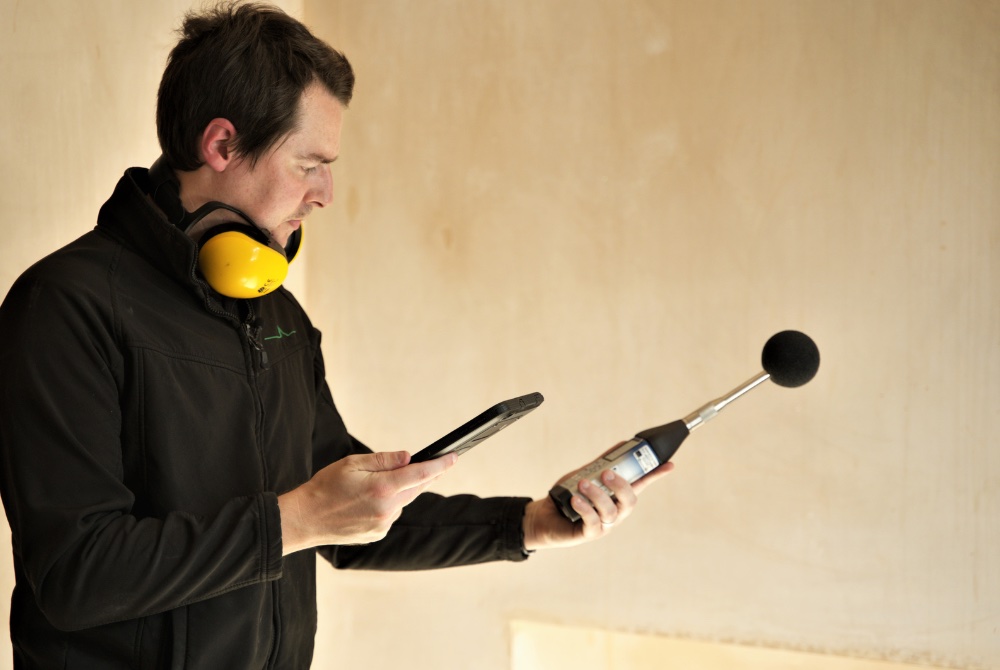
Pre-improvement sound insulation testing is a baseline acoustic test carried out before upgrade works to measure how much sound currently passes through an existing wall or floor. In practical terms, it tells you the starting performance of the separating element so the upgrade can be designed around real evidence rather than guesswork. It is especially useful on existing flats, floor upgrades and conversion projects where the original construction is uncertain.
Pre-improvement testing is diagnostic and design-led; pre-completion testing is formal compliance testing after the works. Approved Document E says sound insulation testing for compliance with Requirement E1 is carried out on site as part of the construction process and refers to that as pre-completion testing. Pre-improvement testing happens earlier to benchmark the existing condition and reduce the risk of designing the wrong upgrade.
Because baseline testing shows what the building is actually doing before you spend money on remedials. ANC guidance for conversions says indicative testing can be carried out before work starts where the existing building is sufficiently intact, and that early expert input improves the chances of passing later formal tests. On live projects, that often means less over-specification, less rework and fewer nasty surprises at handover.
No, not in itself. The legal requirement under Part E is normally the post-works route: either appropriate pre-completion testing or, in eligible new-build cases, the Robust Details route. Pre-improvement testing is optional, but it is a very practical way to inform design and avoid failed final tests on conversions and upgrades.
No. The government’s Part E FAQ states that the Building Regulations are not retrospective, so they do not generally apply to existing buildings just because occupants are unhappy with neighbour noise. That is exactly why pre-improvement sound insulation testing is useful on existing stock: it gives you evidence for upgrade design even where there is no automatic retrospective Building Regulations trigger.
It is most useful where an existing separating wall or floor is going to be upgraded, retained, or relied on for a conversion. Typical examples are commercial-to-residential schemes, apartment floor upgrades, heritage conversions and investigations where the current acoustic performance is unknown. The service is most valuable when the result can still influence the design rather than just explain a failure after the event.
Yes. Conversions are one of the strongest use cases because Approved Document E applies to dwellings and rooms for residential purposes formed by material change of use, and ANC guidance says indicative testing may be carried out before work starts if the existing building is sufficiently intact. It gives the design team a realistic baseline before the final Part E strategy is fixed.
Yes, provided the existing separating walls or floors are still intact enough to test meaningfully. ANC guidance says investigation and indicative test work can be carried out before conversion starts where the retained elements are sufficiently intact. That is often the ideal moment, because you can still change the specification before the programme is committed to the wrong detail.
If the building has already been stripped back, a meaningful baseline sound insulation test may no longer be possible. ANC guidance says that on some conversion projects the retained separating elements are no longer intact enough for indicative testing, so an inspection of the undeveloped construction is undertaken instead. In practical terms, you move from measured baseline testing to investigative acoustic design advice.
It measures how much sound passes through a separating wall or floor between two rooms. The test works across multiple frequency bands and then reports a single-number result for comparison and design use. In plain terms, it tells you how effective the existing partition is at stopping sound moving from a source room into a receiving room.
Airborne testing checks sound like speech, TV or music passing through a wall or floor, while impact testing checks sound generated by direct contact with the floor, such as footsteps or banging. SITMA explains that side-by-side dwellings usually need airborne testing only, while stacked dwellings typically need both airborne and impact testing because sound is travelling vertically as well as horizontally.
DnT,w + Ctr is the single-number result used to characterise airborne sound insulation between rooms in Part E field testing. Approved Document E defines it as the measured airborne insulation, with the Ctr term adjusting the result to account for a spectrum that is more representative of low-frequency domestic noise. For designers and site teams, it is the main airborne number that later gets compared with Part E targets.
L’nT,w is the single-number result used to characterise impact sound insulation of floors in field testing. Approved Document E defines it as the weighted standardised impact sound pressure level. In practical terms, it is the number used to judge how much tapping or footfall noise is arriving in the room below, and lower values are better.
Yes. For airborne sound insulation, a higher DnT,w + Ctr value means more sound is being stopped between rooms. That is why the Part E tables set minimum airborne values. For baseline testing, the closer the existing wall or floor is to the relevant target, the less aggressive the upgrade may need to be.
Yes. For impact sound insulation, a lower L’nT,w value is better because it means less tapping-machine noise is being measured in the receiving room. Approved Document E therefore sets maximum impact values, not minimum ones. On pre-improvement floor testing, this is often the number that shows whether a basic floor-covering approach is likely to be enough or whether a deeper floor build-up is needed.
For separating elements between dwellings and flats, Approved Document E Table 0.1a sets 45 dB DnT,w + Ctr and 62 dB L’nT,w for purpose-built dwellings, and 43 dB DnT,w + Ctr and 64 dB L’nT,w for dwellings formed by material change of use. For rooms for residential purposes, Table 0.1b uses 43 dB for walls and 45/62 or 43/64 for floors depending on whether the building is purpose built or formed by change of use.
No. A pre-improvement result is a baseline, not a final compliance result. Existing buildings being investigated before upgrade often fall well short of the eventual target, which is precisely why the testing is being done. The important point is that if the project is creating new dwellings or rooms for residential purposes, the completed work still needs to satisfy the relevant Part E route.
Yes, sometimes. Approved Document E says an existing construction in a building undergoing material change of use may already achieve the required standards without remedial work if it is generally similar, including flanking constructions, to one of the accepted construction types in the guidance. That is one of the biggest commercial reasons to test or inspect early: sometimes the retained structure is better than the team assumed.
No. It improves certainty, but it does not guarantee success. ANC guidance says early indicative testing and expert advice help maximise the likelihood of passing later sound tests, but final performance still depends on the detailed upgrade, flanking control and workmanship. Pre-improvement testing is there to reduce risk, not replace proper design and proper post-works verification.
They usually fail because the upgrade focused on the obvious element but missed the surrounding acoustic paths. Approved Document E and ANC guidance both stress the importance of associated flanking construction, junctions and continuous elements. On conversion jobs, sound often travels around the new wall or floor through ceilings, external walls, joist zones or other retained fabric, so the partition looks good on paper but still fails on site.
Flanking transmission is sound travelling around the main separating wall or floor rather than straight through it. Approved Document E warns that extensive remedial work to reduce flanking may be needed in conversions, and ANC gives typical examples such as continuous ceilings, floors, voids and lined external walls undermining an otherwise good separating element. In acoustic upgrade work, flanking is often the difference between a pass and a fail.
Because pre-improvement testing is often the first point where flanking risk becomes real rather than theoretical. Approved Document E says special attention is needed where walls or floors are continuous across new separating elements after conversion work, and ANC highlights exactly these details as common reasons for failure. Baseline testing helps show whether the main weakness is the partition itself or the paths around it.
Where possible, the tests are carried out between habitable rooms, typically living rooms and bedrooms. Approved Document E says it is preferable for each formal set of tests to include bedrooms and living rooms, and SITMA notes that testing is normally conducted between habitable rooms, although room layouts do not always make that neat. In practical terms, the tester chooses rooms that best represent the separating element being assessed.
No, not as a standard Part E sound insulation test. Approved Document E says testing should not be carried out between living spaces and corridors, stairwells or hallways, and the official FAQ explains that such spaces can give unreliable results because their shape and volume are difficult to define properly. If that junction is a concern, it needs design review rather than relying on a standard test setup.
Yes, in most cases you do. Sound insulation testing is carried out between a source room and a receiving room, so meaningful testing normally needs access on both sides of the separating element. That is why neighbour liaison is often one of the first practical issues to resolve on existing flats and occupied buildings before a baseline test can happen.
For a full formal set in flats with both separating walls and floors, yes, typically at least three flats are needed. Approved Document E says a full set of tests in that situation normally comprises six individual tests and notes that access to at least three flats will be required. A pre-improvement diagnostic exercise can be more focused, but the formal compliance route is more demanding.
Yes. Current field sound insulation standards are intended for use in both unfurnished and furnished rooms, and pre-improvement testing is commonly used on existing occupied buildings because the point is to understand the building before works begin. The practical issue is access, background noise and cooperation from occupants, not whether occupation automatically prevents the test.
Yes, they can. Approved Document E is explicit that impact tests should normally be carried out without a soft floor covering, because carpet or similar finishes can materially improve the measured result. Furnishings also affect room acoustics and reverberation, which is why measured results need to be interpreted in context if you are comparing an occupied baseline with a later Part E-style compliance target.
Usually, yes. Approved Document E says impact tests should be done on a floor without a soft covering, except for limited cases where the soft layer is integral to the floor type. If a carpet is left down, the result may be useful as a real-world baseline for the occupier, but it is less useful for predicting whether the stripped-back separating floor itself will comply after works.
Not normally as part of site sound insulation testing. SITMA explains that internal partitions are not usually tested on site because there is always a doorway route that lets sound travel around or through the opening, which would distort the result. Approved Document E deals with internal walls and floors mainly through construction guidance and laboratory values, not through standard field pre-completion testing.
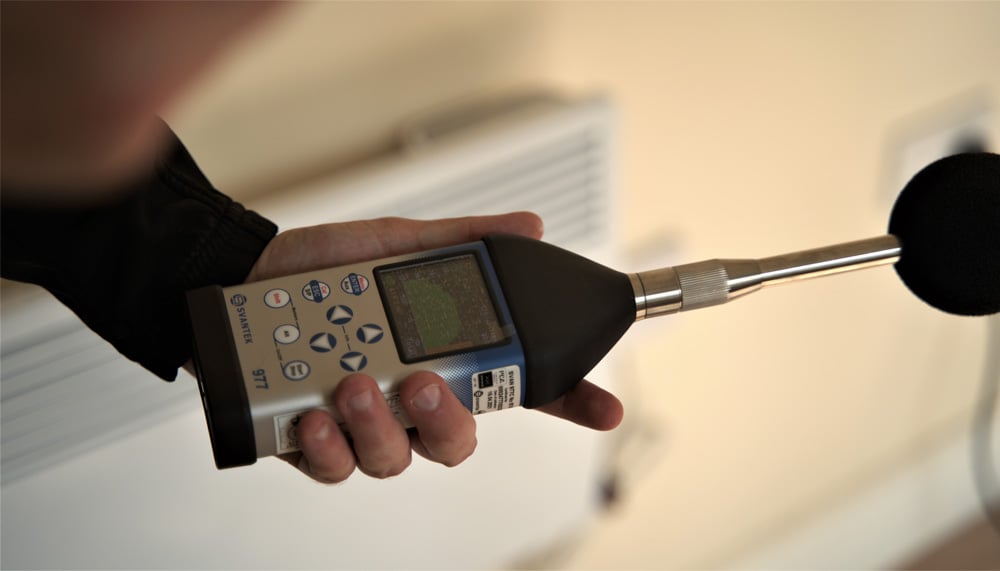
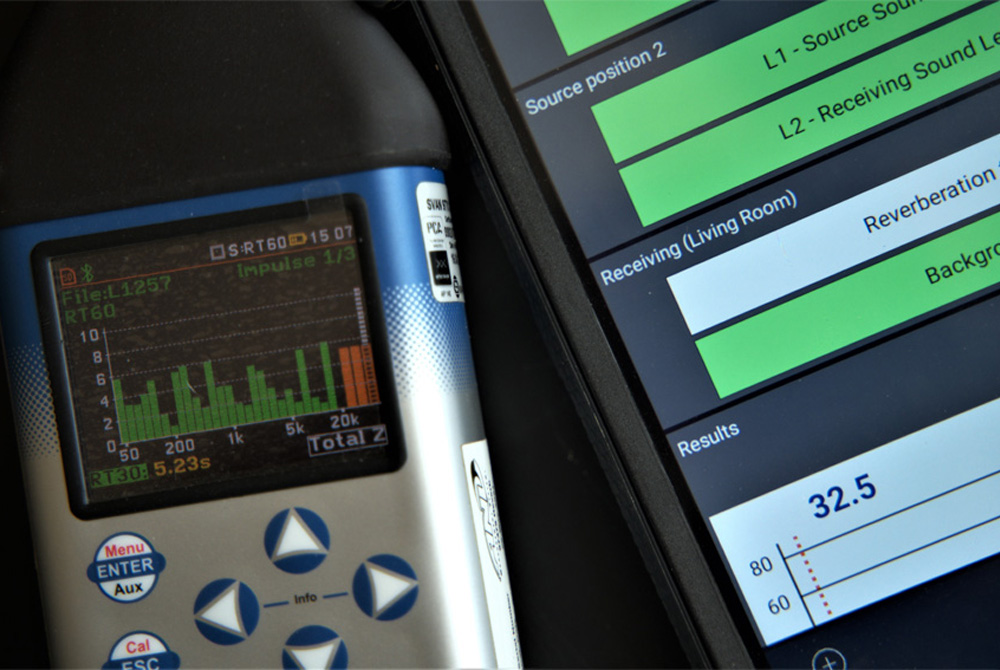
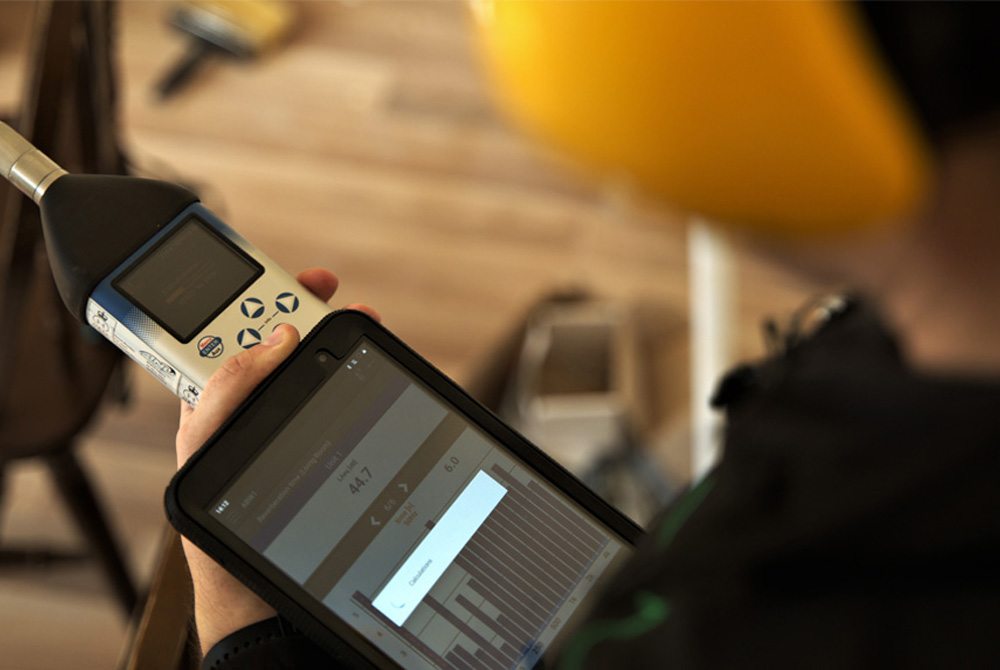
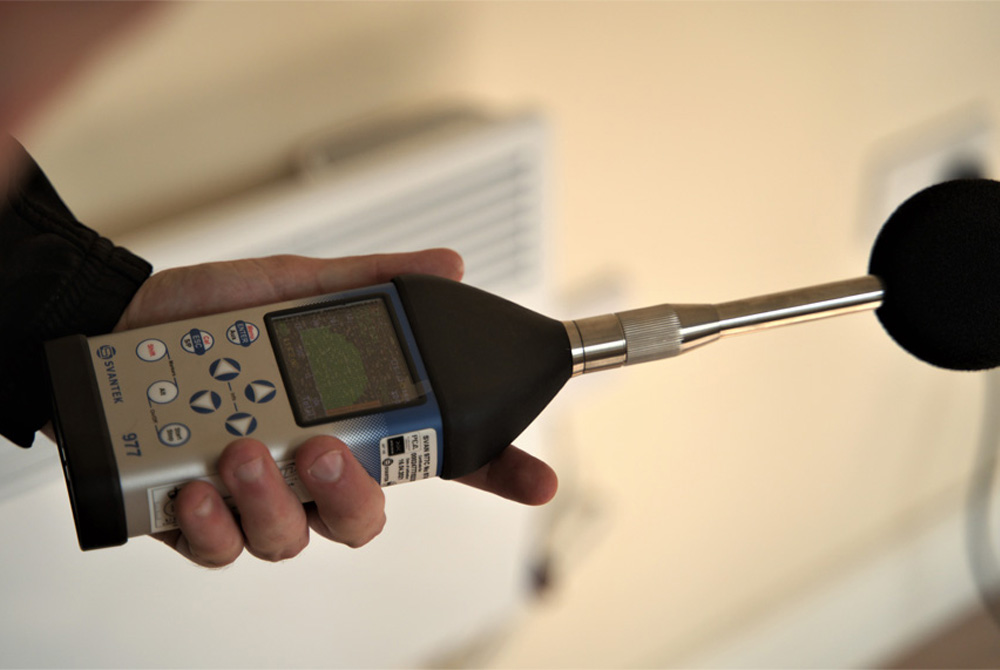
For airborne testing, the core kit is a loudspeaker, sound level meter and building acoustics software. For impact testing, the key item is the tapping machine, plus sound level meter and reverberation-time setup. SITMA’s published FAQ lists this standard equipment, and the testing method also requires calibrated instrumentation and controlled measurement conditions.
For formal Part E testing, Annex B of Approved Document E still calls up BS EN ISO 140-4:1998, BS EN ISO 140-7:1998, and the BS EN ISO 717 rating standards. At the same time, current field measurement practice has moved on to the ISO 16283 series, with ISO 16283-1 confirmed current in 2025 and BS EN ISO 16283-2:2020 current for impact testing. A competent tester should understand both the regulatory route and the current measurement framework.
Use a tester with appropriate third-party acoustic accreditation and real experience of existing buildings. Approved Document E says sound insulation testing should be carried out by a test body with appropriate third-party accreditation, preferably UKAS or equivalent, and it also recognises ANC Registration Scheme members as suitably qualified for pre-completion testing. On pre-improvement jobs, practical diagnostic experience matters just as much as the badge.
The main requirements are access to the source and receiving rooms, quiet conditions, power for the equipment, and a clear understanding of which wall or floor is being assessed. SITMA says testing is ideally carried out when rooms have doors and windows installed, power is available and the site is quiet enough. For existing occupied buildings, the same principle applies: the better the preparation, the more useful the baseline result.
There is no single fixed duration because it depends on the number of airborne and impact tests, the access arrangements and how quiet the site is. Provider guidance aimed at live projects notes that each individual test is relatively quick once conditions are right, but the real time driver is usually room access, setup and keeping background noise low enough for valid measurements.
Cost is mainly driven by scope: airborne only or airborne plus impact, one wall or a full floor package, number of rooms, number of visits, location and how difficult access is. Acoustic providers routinely note that fees depend on the number of required tests, site visits and development size rather than one flat headline rate. On existing buildings, neighbour access and diagnostic reporting can change the price quickly.
You should get more than a raw decibel figure. Approved Document E sets out the core information expected in formal reports, including the rooms tested and the measured single-number quantities. On a pre-improvement job, a useful report should also explain what the numbers mean for the retained construction, what the likely weaknesses are, and how the results should influence the upgrade detail.
Yes. That is one of the main reasons to do the test. ANC says sound insulation of proposed construction methods can be analysed for compliance with Approved Document E, and where proposals are not finalised at survey stage, specifications can be given. A good baseline test stops the acoustic design from being based solely on assumptions about what the existing wall or floor might be doing.
Yes, very often. Approved Document E recognises that some retained constructions in material-change-of-use projects may already be capable of meeting the relevant standard without remedial work, and ANC says pre-work testing or inspection can inform the final construction proposals. That means the team can spend money on the weak points and flanking paths instead of automatically throwing depth and mass at the whole build-up.
Yes. It is particularly useful where an upper-flat floor is being upgraded and you need to understand the existing airborne and impact performance before specifying the new build-up. Published acoustic guidance for pre- and post-works floor testing treats the pre-works test as the baseline stage that informs the necessary soundproofing measures, which is exactly the commercial value of the service on live apartment refurbishments.
Yes. ANC’s conversion guidance is explicit that existing buildings being converted to residential often need early acoustic investigation, including indicative testing where the retained construction is sufficiently intact. It also highlights the extra challenges where ground-floor commercial uses are retained, because both internal separation and the wider sound climate can affect the eventual residential standard.
No. Pre-improvement sound insulation testing is mainly about how sound passes through the building fabric, whereas BS 8233 and BS 4142 are used to assess external or environmental noise conditions in different ways. ANC’s conversion guidance treats these as related but distinct workstreams: one for the internal separation strategy and one for the wider acoustic environment affecting the development.
Yes, and these are often the projects where early testing is most valuable. Historic England highlights that, for some historic buildings undergoing material change of use, it may not be practical to reach the standard Part E values in full, so the aim is to improve sound insulation as far as is practically possible without harming the building’s significance or long-term condition. A baseline test helps that balance become evidence-led.
Approved Document E allows a pragmatic approach in some historic material-change-of-use cases. It says building control bodies should be satisfied that everything reasonable has been done to improve the sound insulation, and Historic England repeats that the obtained test values may need to be displayed in a conspicuous place inside the building. In those cases, pre-improvement testing helps define what “reasonable improvement” looks like before money is spent.
No. It is an early-stage diagnostic and design tool, not the formal compliance evidence. Approved Document E says compliance with Requirement E1 is demonstrated through the approved sound insulation testing programme after the work is done, unless a permitted alternative route is used. Pre-improvement testing helps you design to the right answer; it does not remove the need to prove the finished result.
No, not on a change-of-use conversion. Robust Details says its scheme is the alternative to pre-completion sound testing in new attached dwellings, and industry guidance is clear that conversions to existing buildings are not included. For conversions, the surrounding retained structure is too variable, so the normal approach is still proper design plus formal post-works testing.
Yes, provided the testing brief is set up sensibly and you understand what has changed between the two stages. Comparing a baseline against the finished result is one of the best ways to prove whether the upgrade really worked. The comparison is strongest when the same type of separating element is tested and the team records practical differences such as carpets, room condition and access arrangements.
The main reasons are simple: the retained element is no longer intact, there is no access to both sides, the site is too noisy for reliable measurement, or floor finishes and occupation conditions make the result hard to compare with the eventual post-works target. ANC specifically notes that some buildings are no longer intact enough for indicative testing, and SITMA stresses the need for quiet conditions and proper readiness.
It moves the risk earlier, while the team can still do something intelligent about it. ANC says the best way to maximise the chance of passing later sound tests is to seek expert guidance before construction starts, and Approved Document E says specialist design advice should be sought early where needed. On live projects, that is the difference between controlled design development and expensive acoustic rework.
Use it before the upgrade design is locked, while the existing construction is still intact enough to tell you something useful. The strongest route is baseline testing or inspection, then acoustic design focused on the real weak points, then final post-works testing to verify the completed build. That sequence gives the design team evidence, reduces guesswork and makes first-time pass success far more realistic.
Videos for pre-improvement sound insulation testing
Explore our videos for quick, engaging insights on building compliance. From step-by-step guides to expert advice, our video library simplifies complex topics, making it easier for you to take action and stay informed. Perfect for when you need clarity in minutes!