Retrofit Air Leakage Testing Knowledge Hub
Frequently asked questions
Retrofit air leakage testing is a pressure test used on existing buildings to measure how much uncontrolled air leaks through the envelope before or after improvement works. In practical terms, it gives a measured baseline, helps identify where heat is being lost through draughts and gaps, and shows whether retrofit work has genuinely improved airtightness rather than just looking better on paper.
Yes, in most UK retrofit projects, retrofit air leakage testing and a blower door test mean the same fan pressurisation method. The building is put under a controlled pressure difference and the airflow needed to maintain that pressure is measured. On retrofit jobs, the difference is usually in the purpose: the test is often being used for diagnosis, baseline evidence and before-and-after comparison, not just formal compliance.
It is useful because retrofit changes how an existing building breathes. Approved Document F says many existing dwellings rely heavily on infiltration for ventilation, and energy efficiency measures can reduce that infiltration enough to create under-ventilation if nobody checks the result. Air leakage testing gives the project team measured evidence, so airtightness improvements and ventilation decisions can be made together instead of guessed separately.
No, not as a blanket rule. There is no general UK rule saying every retrofit project must have a formal air leakage test in the way new dwellings do. In practice, it becomes valuable where the work is likely to change airtightness materially, where ventilation needs to be reassessed, or where the client wants measured before-and-after evidence instead of relying on assumptions.
Not automatically. Current research for DESNZ notes that existing dwellings do not have a universal air permeability compliance threshold to meet after retrofit, even though new dwellings do. That said, Approved Document F allows expert advice on existing homes to include an air permeability test, so testing is often the smartest way to judge how much the retrofit has changed the building and whether the ventilation strategy still makes sense.
Not as a default every time, but you should not ignore airtightness on commercial refurbishment. Approved Document F Volume 2 says that where work to an existing building is likely to increase airtightness, it should be demonstrated to Building Control that the ventilation requirements are still met. In real project terms, that makes air leakage testing a very practical tool on refurbishment, façade replacement and major service-upgrade jobs.
No single universal pass mark applies across retrofit work. Existing-home retrofit currently does not have the same across-the-board airtightness threshold that new-build Part L compliance uses, so the meaningful target is usually project-specific. A good retrofit brief sets a clear aim at the start: diagnose draughts, verify improvement, inform ventilation design, support PAS 2035, or benchmark a portfolio for future works.
A good retrofit result is one that materially improves the home against its own starting point without creating a ventilation problem. Recent DESNZ work found the GB housing stock had a mean air permeability of 8.6 m³/(h·m²) at 50Pa, with a very wide spread, so “good” in retrofit is about meaningful improvement and healthy ventilation, not blindly chasing new-build numbers on an older property.
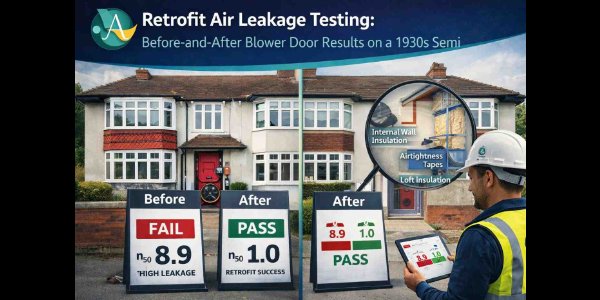
Yes, and that is one of the strongest uses of retrofit air leakage testing. Recent deep-retrofit case studies used blower door testing at baseline and again after retrofit stages to show how airtightness changed and to estimate the effect on ventilation heat loss. That kind of before-and-after evidence is far more useful for quality control than trying to judge success by feel alone.
Carry out the baseline test before major fabric works begin, while the building still reflects its real pre-retrofit condition. That gives the design team a measured starting point, helps identify major leakage routes and makes later results meaningful. For deeper retrofit, the baseline number is often just as valuable as the final one because it tells you what the project actually changed.
The post-retrofit test should be carried out when the relevant airtightness works are complete and the building is in the condition you want to assess. On staged retrofit that may mean more than one visit: an interim check while details are still accessible, then a final verification test once the completed retrofit package is in place. That approach reduces guesswork and helps avoid buried defects.
Yes. PAS 2035 uses a whole-house retrofit process, and Approved Document F says following PAS 2035 is considered an adequate means of demonstrating compliance for ventilation in existing dwellings. A measured air leakage test strengthens that process because it gives the Retrofit Coordinator and designer real evidence about infiltration, likely ventilation impact and whether the retrofit is delivering what the assessment assumed.
Yes. Approved Document F in both England and Wales says many existing dwellings rely on infiltration and that energy efficiency measures may reduce that infiltration enough to cause under-ventilation. Retrofit air leakage testing gives measured evidence of how tight the home has become, which helps decide whether the existing vents and extract are still adequate or whether the ventilation strategy needs upgrading.
Yes. PAS 2038 is the recognised route for non-domestic retrofit, and airtightness evidence can be very useful where commercial refurbishment is likely to change infiltration, comfort and ventilation performance. Approved Document F Volume 2 makes clear that increased airtightness in existing non-domestic buildings has to be considered alongside ventilation, so measured testing can reduce risk on offices, public buildings and other live refurbishment projects.
Yes. Approved Document F expressly says expert advice on an existing dwelling may include carrying out an air permeability test following the Approved Document L testing procedures. That is important because it moves retrofit air leakage testing out of the “nice to have” category. On the right project, it is a sensible evidence-based way to decide what airtightness changes have actually happened and what the ventilation response should be.
Yes, very often. Approved Document F notes that replacing existing windows can improve airtightness and therefore reduce adventitious ventilation. That is one reason window upgrades sometimes leave occupants complaining about stuffiness or condensation afterwards. The heat loss may improve, but the background ventilation picture may have changed at the same time, so it is worth measuring the effect rather than assuming the job is neutral.
Usually, yes, unless you are providing an equivalent ventilation solution. Approved Document F says if the original windows had background ventilators, the replacements should include them, and where windows without vents are replaced the new work should not leave the dwelling worse off for ventilation. The guidance also gives common replacement equivalent areas such as 8,000mm² in habitable rooms and kitchens and 4,000mm² in bathrooms in typical dwelling scenarios.
Yes. Testing gives the team a measured picture of uncontrolled ventilation losses rather than relying entirely on assumptions. Historic England’s building performance work says air tightness testing helps quantify heat loss through air leakage in existing buildings, and recent deep-retrofit case studies used blower door results to estimate ventilation heat loss across retrofit stages. That makes the design and business case more grounded.
Yes, when it leads to targeted airtightness improvements done with ventilation in mind. Reducing uncontrolled leakage cuts unwanted heat loss, and DESNZ research highlights sealing openings, windows, doors and service penetrations as effective airtightness measures. The key is targeting the real leakage paths, not sealing blindly, because the best outcome is lower heat loss without creating stale-air or moisture problems.
Yes. A property can have new insulation or windows and still feel draughty if the main air leakage paths were never tackled. Retrofit air leakage testing helps show where air is still moving through the fabric, around junctions and through service penetrations, so the remedial work can be focused on the true cause of discomfort rather than guessed from finishes or product labels.
The main equipment is a fan pressurisation system, usually called a blower door, used to create a pressure difference across the building envelope. On retrofit projects that core setup is often supported by smoke, thermal imaging and other diagnostic tools so the survey does more than produce a number. The aim is to find where air is leaking and why, not just confirm that leakage exists.
Yes. Smoke is one of the quickest ways to show where air is moving through gaps, cracks and junctions during a retrofit air leakage survey. It is especially useful in older buildings and occupied properties because the leakage path becomes visible to the installer, project manager and client at the same time. That usually makes remedials faster and more precise.
Yes. Thermal imaging is a very useful companion to retrofit air leakage testing because it helps show where cold air paths and weak details are affecting the thermal envelope. Used alongside a pressure difference, it can reveal leakage routes that are hard to identify by eye alone. That makes it valuable for diagnosis, staged retrofit quality checks and explaining problems clearly to building owners.
No. A pulse test is a different airtightness measurement method that works at much lower pressure, while a blower door test uses sustained fan pressurisation or depressurisation. Both can be useful in retrofit, but a blower door test is still the more familiar route when you need detailed leakage diagnosis and a conventional air permeability result for comparison.
The biggest airtightness changes usually come from measures that directly alter the envelope or its leakage paths, such as new windows and doors, draught-proofing, service-penetration sealing, internal lining works and broader fabric upgrades. DESNZ research shows openings, windows, doors and service penetrations are among the measures most likely to affect airtightness materially. In retrofit, it is the cumulative effect of several small changes that often matters most.
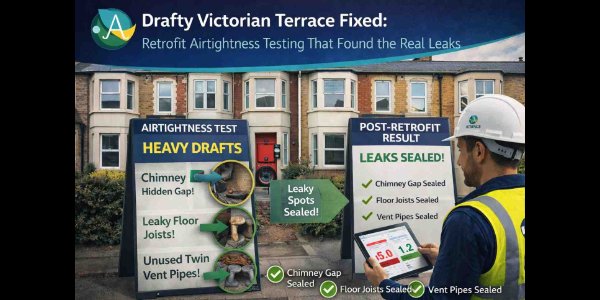
The most common leakage points are usually service penetrations, weak junctions, openings around windows and doors, loft hatches, chimneys, and areas where old and new work meet badly. DESNZ research also points to careless interaction with the primary air barrier and poor workmanship as repeated causes of leakage. In other words, retrofit failures are usually about interfaces and execution, not a lack of sealant.
They are a big problem because retrofit often adds or alters services after the original building fabric was formed, so every new pipe, cable or duct is another chance to break continuity. DESNZ research identifies service penetrations as one of the most typical airtightness failure points in UK housing. They are also easy to underestimate because a few small holes can link into much larger hidden leakage routes in the fabric.
Yes. Internal linings, skirtings and floor-edge works can either improve airtightness or hide leakage, depending on how well the interfaces are detailed. On retrofit jobs, these are the places where concealed voids and junction problems often get covered before anyone realises the air path is still open. That is why before-and-after testing and targeted diagnostics are so useful on internal upgrade works.
Yes. Historic England’s guidance notes that unused or intermittently used chimneys can contribute significantly to draughts and heat loss, while loft hatches and similar small details are often disproportionate leakage points in older buildings. The point is not to block everything blindly, but to deal with these routes in a way that reduces unnecessary heat loss without compromising intended ventilation or combustion safety.
It can, if the ventilation strategy is not reviewed at the same time. Approved Document F warns that reducing infiltration in an existing dwelling can reduce indoor air quality below the required standard, and the same logic applies to moisture risk. Airtightness improvement is not the enemy; unmanaged airtightness improvement is. The safe retrofit approach is to tighten and ventilate in a controlled way together.
Yes, it can help inform that decision. The test does not design the ventilation system on its own, but it gives the designer or assessor evidence about how much incidental infiltration the building still has. Once a retrofit makes the home materially tighter, the case for better extract, continuous mechanical ventilation or a more considered whole-house strategy becomes easier to judge properly.
Under Approved Document F, a highly airtight dwelling is one with a design air permeability below 5 m³/(h·m²) at 50Pa or an as-built value below 3. That matters because once a retrofit home becomes that tight, you should not assume background leakage will still help ventilate it. At that point, the ventilation strategy needs much closer attention.
Yes, and it can be especially useful there, provided the interpretation is sensible. Historic and traditional buildings often behave differently from modern construction, and Welsh guidance also recognises special considerations for permeable fabric and traditional forms. Testing can help establish a real baseline and show where draughts are occurring, but remedial decisions still need to respect breathability, heritage value and moisture risk.
Yes, usually, but it should be selective and informed. Historic England is clear that draught-proofing can be beneficial, but older buildings often rely on certain ventilation routes, and some spaces such as roof voids, subfloors and rooms with combustion appliances should not simply be sealed up. On traditional buildings, the smart approach is controlled draught reduction, not blanket closure of every air path.
Yes. Large-scale retrofit programmes benefit from measured baseline and post-works evidence because repeated dwelling types, repeated defects and repeated details can otherwise hide in plain sight across whole portfolios. Deep-retrofit case studies have used blower door testing at multiple stages to verify improvement, and that same logic is valuable on social housing, apartment and multi-unit upgrade programmes where consistency matters just as much as one-off performance.
Yes, often they can, but they need more planning than empty properties. Historic England notes that testing existing buildings can require sealing preparation, filled water traps and sometimes out-of-hours access depending on the building and the brief. On occupied homes, the main issue is coordination: access, ventilation settings, doors, windows and occupant activities all have to be managed so the result is meaningful.
Yes, but careful planning is essential. Live commercial buildings bring extra complexity around access, pressure boundaries, operating ventilation systems and disturbance to occupants. Historic England notes that airtightness testing may need specific preparation and out-of-hours working, while Approved Document F Volume 2 makes clear that changes in airtightness still have to be considered alongside ventilation in existing buildings. That is why occupied retrofit testing works best when it is planned into the programme early.
There is no single fixed duration. A simple existing-home blower door test can be relatively straightforward once the property is prepared, but occupied buildings, diagnostics, smoke work, thermography and multi-zone refurbishment all take longer. On retrofit jobs, preparation is often the real time driver: access, sealed openings, water traps, ventilation settings and coordination with occupants or site teams can matter as much as the fan test itself.
Cost is driven by scope more than by the fan itself. A single baseline blower door test on one property is a very different job from a staged retrofit package covering pre-works testing, post-works verification, smoke, thermography and reporting across occupied units. Size, access, number of visits, diagnostics and the level of evidence you need for design or asset planning are usually the biggest price drivers.
You should get more than just a headline number. A useful retrofit air leakage report normally gives the measured result, explains what that means for the building, and where relevant identifies the main leakage paths and likely next steps. On before-and-after retrofit work, the real value is the evidence it creates for design decisions, ventilation review, QA and proving whether the upgrade actually worked.
Yes. DESNZ research that revisited homes around ten years after earlier tests found airtightness had deteriorated in seven out of ten cases, with an average worsening of 0.52 m³/(h·m²) at 50Pa. That is why retrofit airtightness should be treated as a durability issue, not just a handover-day number. Good detailing and robust sealing matter more than cosmetic last-minute fixes.
No. Air leakage testing tells you how much uncontrolled air is moving through the fabric, but it does not prove the ventilation system is delivering the airflow rates it should. Those are separate questions. On retrofit, the biggest mistake is to assume a tighter building automatically means a properly ventilated one. It does not. Airtightness evidence and ventilation commissioning need to work together.
Yes. Mechanical ventilation still needs proper commissioning and, where the regulations require it, airflow measurements and handover information. That applies in dwellings and also in non-domestic settings where new or altered systems are part of the work. A tighter envelope does not remove that duty. In fact, once infiltration has been reduced, correct ventilation commissioning becomes even more important.
Yes. Historic England says air tightness testing can quantify heat loss through air leakage in existing buildings and inform both energy baselines and proposed improvement measures. That makes it useful for housing portfolios, public-sector estates and commercial asset strategies where the goal is not just to fix one building, but to prioritise the right upgrades across many buildings with real measured evidence.
Yes. Phased or staged testing is one of the best QA tools in retrofit because it shows whether each work package is improving the building or simply hiding leakage behind finishes. Deep-retrofit case studies have used testing at multiple stages, and good-practice guidance supports interim testing while the relevant details are still accessible. That helps catch repeated mistakes before they spread across the rest of the programme.
Yes. It is particularly useful on deep retrofit where the building changes in stages and the interaction between measures is not always obvious from drawings alone. Recent staged retrofit case studies used blower door tests at baseline and across retrofit phases to track changes in airtightness. That kind of staged evidence helps the team understand what each intervention is doing rather than waiting until the end and hoping it all adds up.
Use an airtightness specialist who understands existing buildings, ventilation and diagnostic fault-finding, not just new-build compliance testing. Approved Document F also makes clear that “expert advice” on existing dwellings should come from a competent person, and Wales gives examples of the kinds of professionals who may provide that advice. On PAS 2035 projects, that evidence then feeds the wider Retrofit Coordinator-led process.
Prepare it exactly as the tester instructs, but expect the basics to include controlled access, closed windows and doors, attention to ventilation settings, filled water traps and clear access to key areas. Historic England notes that preparation may also require sealing certain openings and, on some buildings, carrying out the survey out of hours. Good preparation is what stops a retrofit test from becoming a wasted visit.
The biggest mistakes are sealing without checking ventilation, relying too heavily on secondary sealants, and treating retrofit airtightness as a snagging issue rather than a design-and-delivery issue. DESNZ research highlights overreliance on secondary sealing as poor long-term practice, and Approved Document F is clear that tightening an existing building can reduce ventilation below a satisfactory level if nobody checks the outcome.
Use it early, use it in stages where needed, and use it alongside ventilation review rather than after the fact. The strongest retrofit process is baseline test, targeted design, interim checks where details are still accessible, then post-works verification to prove the result. That approach reduces wasted remedials, protects indoor air quality and gives the project team evidence they can actually build decisions around.
Videos for retrofit air leakage testing
Explore our videos for quick, engaging insights on building compliance. From step-by-step guides to expert advice, our video library simplifies complex topics, making it easier for you to take action and stay informed. Perfect for when you need clarity in minutes!