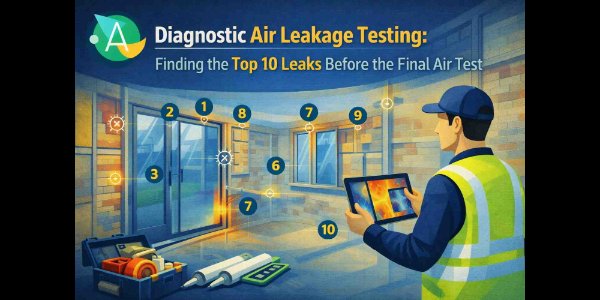
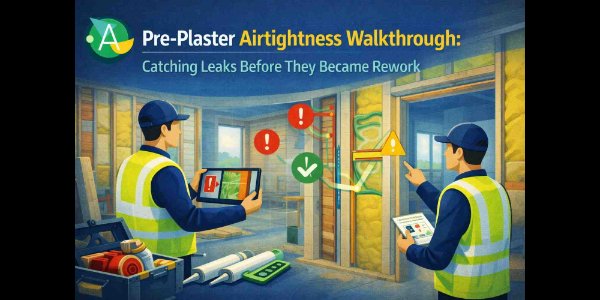
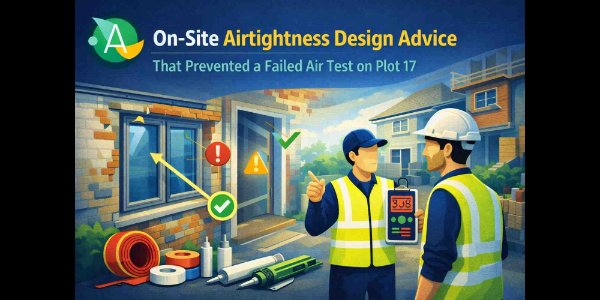
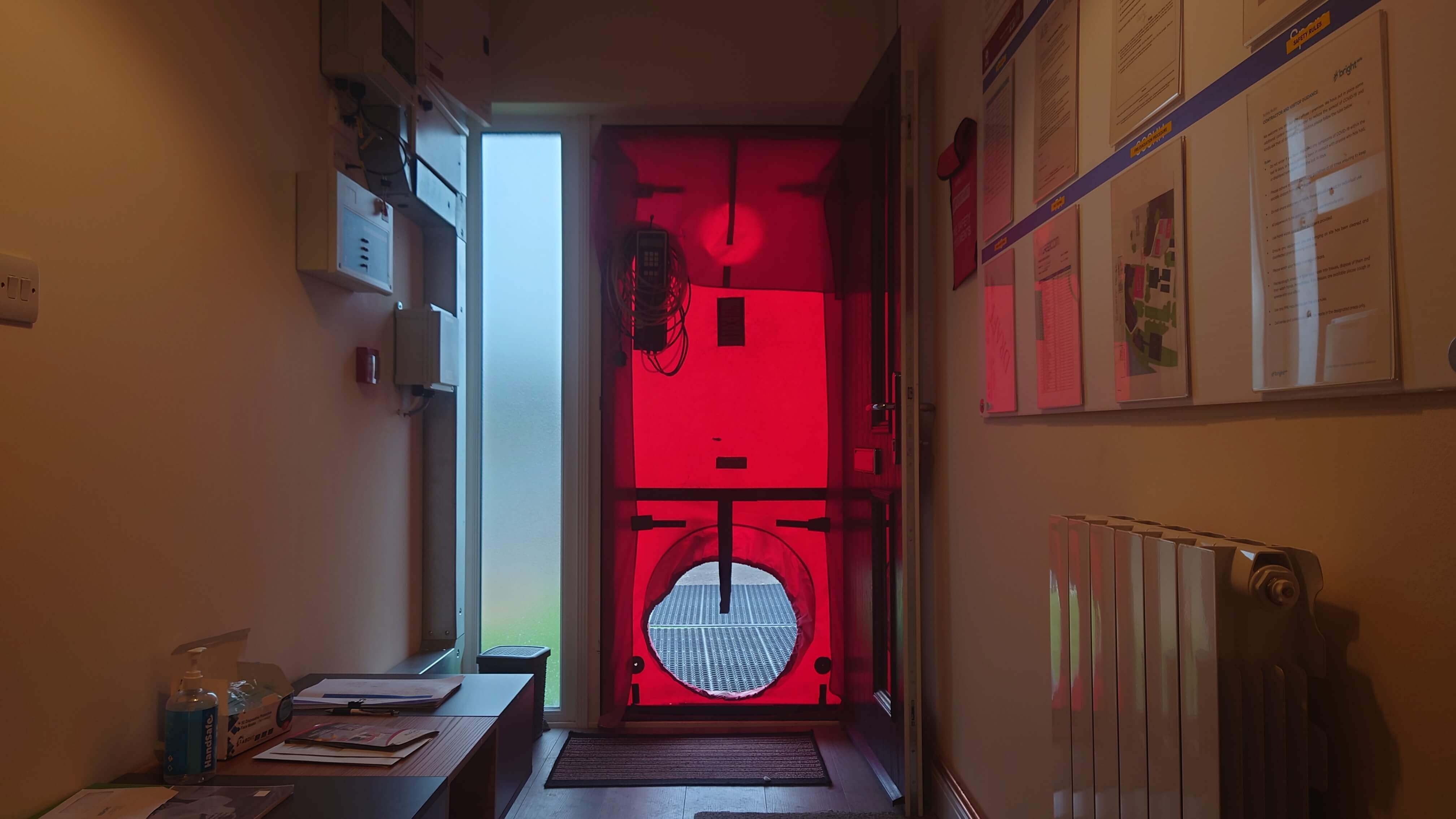
Air leakage on-site design advice is proactive airtightness support that helps the design and site team define the air barrier, review junctions and penetrations, and check workmanship before hidden defects are sealed in. In practice, it sits between pure design and the final test. The aim is simple: make the air barrier clear, buildable and continuous, so the project is not relying on last-minute sealing to hit its target.
Air leakage on-site design advice is prevention; an air leakage test is verification. The advice happens earlier and focuses on drawings, sequencing, interfaces and site quality checks, while the formal test measures the finished building’s air permeability and feeds the compliance process. One helps you avoid problems; the other proves what was actually built. The strongest projects use both, not one instead of the other.
Because airtightness problems are far cheaper to solve on drawings than on finished plots or completed façades. ATTMA’s guidance is clear that the earlier problems are identified in design, the more cost-effective the remedies are, and Approved Document L also expects critical details to be checked before they are concealed. On site, that means fewer nasty surprises at handover and less chance of remedial sealing becoming a programme issue.
Book it as early as the project has a target and developing detail package, then use it again before hidden works are closed up. Good airtightness delivery is not a one-off meeting. The most useful stages are technical design, pre-start, early site setup, first key interface installations, and the point just before dry-lining or finishes hide the air barrier. That is where buildability and sequencing issues usually show up.
No. It is just as useful on straightforward Part L projects as it is on low-energy or Passivhaus schemes. Approved Document L already expects clear air barrier drawings, continuity of insulation, buildable junctions and on-site audits before details are concealed, so even “standard” projects still need airtightness thinking. The service becomes more valuable as targets tighten, but it is not only for specialist buildings.
Yes. Part L compliance depends on more than a final test number, and airtightness design advice helps the team build what the compliance model assumed. In dwellings, the final energy calculation uses the measured air permeability; in non-domestic buildings, the as-built calculation also uses the measured result. Good on-site advice helps protect that design target by dealing with air barrier continuity and workmanship before defects become compliance failures.
Yes. Airtightness and ventilation have to be designed together, not as separate workstreams. Approved Document L explicitly says infiltration should be considered when specifying purpose-provided ventilation and directs users to Approved Document F. If a building is tightened without thinking about the ventilation strategy, you can solve one problem and create another. Good advice keeps the fabric target and ventilation design aligned from the start.
Architects, developers, main contractors, site managers, façade teams, retrofit teams, housebuilders and self-builders can all benefit from it. The common factor is responsibility for delivering a real, buildable air barrier rather than just specifying one. Current approved documents make clear that designers, builders, installers and owners all have responsibilities in meeting the regulations, so airtightness is rarely owned by just one person on a live project.
A proper review usually includes air barrier drawings, key junctions, service penetrations, product compatibility, sequencing, hold points, installer responsibilities, evidence capture and the testing plan. On larger projects it can also include site management procedures, a roles matrix, training needs and interim testing or leakage investigation strategy. The point is to turn airtightness from a vague aspiration into a controlled build process.
Review all drawings that affect the envelope, not just one “airtightness detail” sheet. Approved Document L expects drawings to clearly identify the position, continuity and extent of the air barrier, and it also expects insulation layers and junction details to be checked for continuity, buildability and sequencing. In practice, that means plans, sections, wall types, roof details, window interfaces, penetrations and service routes all need reviewing together.
An air barrier strategy is the project-wide plan showing where the airtight layer is, how it connects at every junction, who is responsible for each section, what products are being used and how compliance will be checked. On better-run jobs it also defines management on site, evidence requirements and the testing regime. Without that strategy, teams tend to discover the real airtightness line only when the building fails or comes in too close for comfort.
They matter because airtightness is lost at interfaces, not in marketing brochures. Approved Document L for dwellings says relevant drawings should clearly identify the position, continuity and extent of the air barrier, and those drawings should be reviewed by the designer and installer. If the line is not obvious on the drawings, it will not be obvious on site either. That is where rework usually starts.
The insulation layer slows heat flow; the air barrier controls uncontrolled air movement through the envelope. They often sit close together, but they are not the same thing. Approved Document F defines airtightness as resistance to infiltration, while Approved Document L Volume 2 says the insulation layer should abut the air barrier, or the gap between them should be filled with solid material, to avoid air movement within the construction.
Because airtightness failures are usually caused by missing continuity, weak sequencing or poorly managed interfaces, not by a lack of products on the spec. ATTMA’s guidance stresses continuity at roof, wall and floor connections and asks whether assemblies actually join; the Passivhaus Trust also emphasises sequencing and hold points before follow-on works hide the air barrier. A good specification still fails if the build process breaks it.
Yes. That is one of the main reasons to use it. ATTMA states that the sooner airtightness problems are identified in design, the more cost-effective the remedies are, and official guidance expects on-site audits before details are concealed. In simple terms, early reviews and site checks move failure risk forward to a stage where it can still be fixed properly, instead of leaving everything to the last certificate-critical visit.
The usual culprits are service penetrations, window and door interfaces, meter boxes, junctions at roof and floor level, internal walls crossing the air barrier, and any detail where one trade assumes another trade has sealed it. Dwelling guidance also flags penetrating elements such as steel beams and incoming services, while good-practice guidance repeatedly points to internal wall junctions and penetrations as high-risk areas.
Yes. That is exactly when it should be checked. Approved Document L requires on-site audits before elements are concealed by subsequent work, and those audits should confirm the designed details have actually been built. Once dry-lining, ceilings, joinery or fit-out cover the problem, the same defect becomes slower, messier and more expensive to fix. This is one of the biggest “get it right first time” moments on site.
Yes, on most projects you do. Hold points are the moments where airtightness work must be checked before follow-on trades cover it up. The Passivhaus Trust’s guidance says airtightness workshops should discuss hold points and the testing regime so sealing works are checked before hidden areas are allowed to proceed. On real sites, hold points are what stop airtightness becoming somebody else’s problem later in the programme.
Because they cut straight through the line you are trying to keep continuous. Good airtightness design minimises interactions between services and the air barrier, and the Passivhaus Trust recommends enough spacing between penetrations to make sealing practical. Dwelling guidance also highlights incoming services and recessed boxes as details that must be designed clearly. On site, penetrations often appear late, after the main envelope looked “done”.
Yes, wherever practical. The cleanest airtightness details usually come from keeping services out of the airtight layer rather than trying to seal dozens of late penetrations through it. The Passivhaus Trust specifically recommends minimising interactions between the air barrier and services and notes that a service void can help achieve that. It is a simple move that reduces both workmanship risk and remedial cost.
Usually, yes. Good products help, but airtightness is lost at buildable interfaces, not because a tape brochure was weak. Approved Document L says junctions should be reviewed to check they are buildable and that construction sequencing is properly considered, and ATTMA’s design-stage guidance focuses on whether the wall air barrier actually joins the roof and floor assemblies. Robust junction design beats heroic product use every time.
Yes, it should. Airtightness, insulation continuity and thermal bridging overlap at the same junctions, so separating them too rigidly usually creates problems. Approved Document L for both dwellings and non-domestic buildings links continuous insulation, limited thermal bridging and buildable details, with on-site audits before details are concealed. Good airtightness advice should therefore review leakage risk and thermal continuity together, especially at floors, openings and roof edges.
Yes. For dwellings in England, the completion-stage BREL report is submitted together with photographic evidence, and Approved Document L also expects photos of key details during on-site audits. Airtightness advice helps the site team decide which details need recording, when they need photographing and how to avoid missing evidence once work is covered up. It is as much about organised proof as it is about technical fixes.
Yes. In non-domestic projects, the building primary energy rate and building emission rate are calculated at design stage and again as built, with the measured air permeability included at completion. The BRUKL reports are what tie that compliance evidence together. Airtightness design advice helps protect the design assumptions that sit behind the BRUKL, so the finished building is less likely to drift away from the model during construction.
Yes. A tighter home changes the ventilation assumptions, so the ventilation strategy should always be checked alongside the fabric strategy. Approved Document L tells designers to consider infiltration and follow Approved Document F, and the natural ventilation guidance in Approved Document F is only intended for less airtight dwellings. That is why airtightness advice on housing sites should never stop at tapes and membranes.
That can create a ventilation issue as well as a compliance question. Approved Document F says that where a naturally ventilated dwelling has a measured air permeability that makes it a highly airtight dwelling, expert advice should be sought or a continuous mechanical extract ventilation system should be installed. In plain terms, a “better” air test result is not automatically problem-free if the ventilation design has not kept up.
Yes. Approved Document F is explicit that reducing infiltration in an existing dwelling can reduce indoor air quality below the required standard. It also says the assessment may involve expert advice and can include an air permeability test following Approved Document L procedures. So on retrofit and upgrade work, airtightness advice should look at ventilation impact at the same time as heat loss reduction, not months later when condensation complaints start.
Yes. Approved Document F Volume 2 says reducing infiltration in an existing building can reduce indoor air quality below the performance standards. Where building work affects ventilation, the building should either meet the relevant standards or be no less satisfactory than before. On commercial refurbishments, that means airtightness upgrades, replacement façades and door changes should be reviewed with the ventilation strategy, not treated as isolated fabric work.
Yes. It is especially useful where you are improving fabric performance, changing windows or carrying out wider retrofit work and want to avoid creating draught, moisture or ventilation issues by accident. Approved Document F for existing dwellings specifically anticipates expert advice and even says that may include an air permeability test. In retrofit, good airtightness advice is about balancing heat loss, buildability and healthy indoor air rather than just chasing a low number.
Yes. It can be valuable on refurbishments involving replacement windows, doors, cladding upgrades, material changes of use or broader energy-efficiency work, especially where infiltration is being reduced. Approved Document F Volume 2 notes that tightening a building can affect indoor air quality, and non-domestic Part L work often still depends on getting continuity, buildability and interfaces right. Early advice reduces the risk of fabric upgrades creating follow-on ventilation or handover issues.
Hold it before the build sequence is locked in and certainly before the key airtightness interfaces are installed. Good-practice guidance places airtightness workshops in technical design and pre-construction so the team can review drawings, hold points, sequencing and testing before follow-on works make changes expensive. Waiting until the site is nearly finished turns a useful workshop into a post-mortem.
Everyone whose work touches the air barrier should be in the room. ATTMA’s guidance specifically calls for the client, main contractor, façade consultant and subcontractors for windows, roof and walls, while the Passivhaus Trust recommends at least the architect, contractor and airtightness specialist, with subcontractors included where possible. The point is to solve interface problems before they become trade disputes on site.
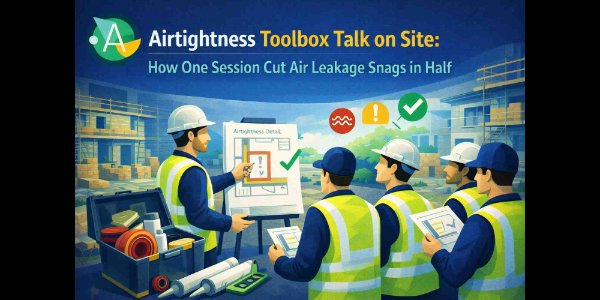
It should cover where the air barrier is, which details are critical, what products and installation rules apply, how to deal with penetrations, what cannot be damaged or cut without approval, and what evidence the team needs to keep. Good-practice guidance says toolbox talks should brief new site workers on airtightness issues and be part of the wider training and QA process. The real aim is clarity, not paperwork.
You do not always need one formally named, but in practice a clear airtightness lead is a very good idea. Good-practice guidance says an airtightness specialist or airtightness champion should review continuity across work packages so responsibilities do not fall between contracts, and toolbox talks are ideally delivered by that person. On busier sites, having no owner for airtightness is usually the fastest route to gaps and finger-pointing.
Yes, and on those projects it is often most valuable. Approved Document L Volume 2 says that where pressure testing is impractical due to size or complexity, the developer may submit a detailed strategy showing how a continuous air barrier will be achieved, and expert advice should be sought to confirm that strategy. Large or phased buildings usually need earlier coordination, more interim checks and a tighter testing plan than simple buildings.
Yes. These projects often have large volumes, repeated interfaces or specialist spaces that make airtightness more dependent on coordination than on any single product. ATTMA’s design-stage guidance highlights spaces with special needs, such as aquatic areas, performance spaces, cold storage and server rooms, as decisions that affect whole-building performance. Early airtightness advice helps those sector-specific demands feed into the enclosure strategy before site works race ahead.
Yes. Shell-and-core projects need very clear agreement on what the base build is delivering, what assumptions sit in the compliance model and how later fit-out works will connect to the envelope without undermining it. Approved Document L Volume 2 in both England and Wales sets out separate shell-and-core procedures and later first-fit-out requirements. Airtightness advice helps fix those boundaries early, which is exactly where these jobs usually get messy.
Yes. Apartment and mixed-use schemes need airtightness boundaries to be agreed properly because dwellings, heated common areas and commercial space are not all treated under the same guidance. Approved Document L Volume 1 applies to the dwellings, while heated common areas and commercial or retail space fall under Volume 2. Good airtightness advice helps teams avoid blurred boundaries that later confuse testing, evidence and sign-off.
Yes. The same airtightness principles apply across all of them, but the detail risk changes by build system. Dwelling guidance expects buildable details, continuity and careful treatment of openings, floors, roofs and penetrating elements, while good-practice guidance notes that some timber details and panel joints need particular care to stay robust through construction. The best advice is system-aware rather than generic.
These are classic high-risk areas and usually deserve focused review. ATTMA’s design-stage guidance asks how the wall air barrier joins the roof and floor and whether materials and sealants are compatible, while good-practice airtightness guidance repeatedly highlights interface continuity and sequencing. Façade packages often look complete in isolation but still leak where they meet the rest of the envelope. That is why pre-installation coordination matters so much.
Yes, especially where the project relies on repeated façade details, unfamiliar interfaces or large areas of the same build-up. ATTMA recommends observing mock-up tests as early as possible and applying the findings going forward, and good-practice guidance for more complex projects also recognises partial, preliminary and localised testing or mock-up delivery as useful verification. It is far cheaper to prove one detail early than to rework a whole elevation later.
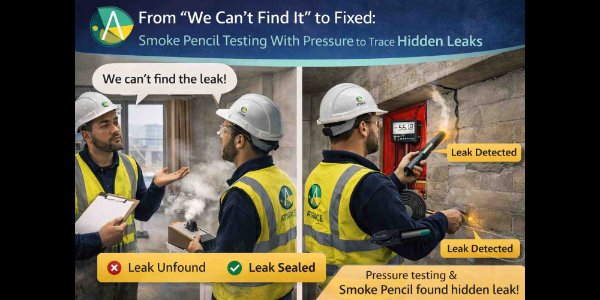
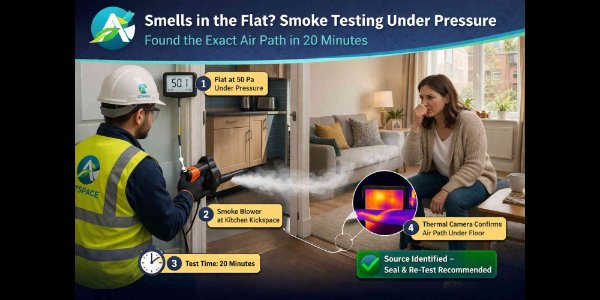
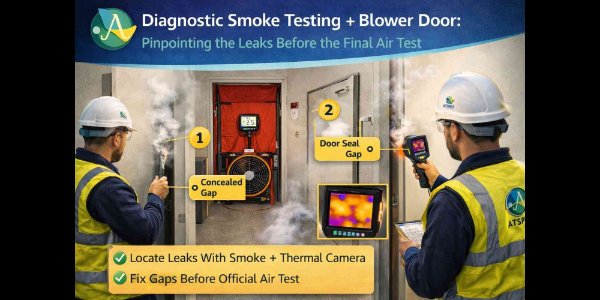
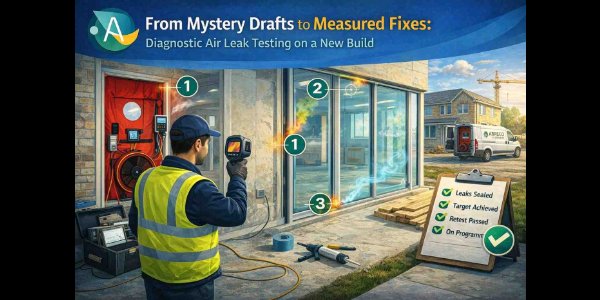
Yes. Smoke testing is an effective way to make invisible leakage obvious to the site team while the air barrier is still accessible. Good-practice guidance says smoke pens can be used to aid leak detection during interim testing, and ATTMA also highlights qualitative tests of building sections to identify and remediate leakage points. That makes smoke a very useful bridge between design intent and practical remedial action.
Yes, as a diagnostic tool rather than a substitute for proper airtightness design or formal testing. Good-practice guidance says thermal cameras can be used to aid leak detection during interim testing while the air barrier is still accessible. On site, that is helpful because it gives visual evidence of weak details and helps the team target the real problem areas instead of sealing randomly and hoping the next test improves.
Usually the opposite. Done properly, it protects the programme by pushing decisions and defects forward to a stage where they can still be fixed cleanly. Good-practice guidance builds airtightness into pre-construction, hold points, site leakage audits and preliminary testing specifically to avoid avoidable failure later. The jobs that suffer delay are usually the ones that leave airtightness until the envelope is finished and handover pressure is already high.
In most cases, yes. ATTMA states plainly that the sooner airtightness problems are identified in the design phase, the more cost-effective the remedies are. Once the issue is hidden behind finishes, fit-out or repeated façade works, every fix costs more in labour, access, rework and programme disruption. Early advice is not an added burden on a healthy job; it is often what keeps remedials from becoming expensive.
Keep the air barrier drawings, key detail drawings, installation photos before concealment, site audit records, specification changes and the final compliance reports. For dwellings in England that means the BREL report and photographic evidence; for non-domestic projects it means the BRUKL reports and supporting specification lists. Good practice also supports retaining sign-off records, installer evidence and photos linked to hold points and site leakage audits.
Yes. It is best brought in early, but it can still add real value once work has started. Good-practice guidance includes site leakage audits, preliminary testing and localised or partial testing specifically to identify weaknesses while the air barrier is still accessible enough to fix. Even on a live site, a focused review can stop repeated bad details spreading across the rest of the programme.
Cost is mainly driven by scope and complexity. A simple one-off site review is very different from a full package covering design review, workshops, repeated site visits, evidence strategy, preliminary testing and support on a large or phased building. The more interfaces, unusual details, fit-out uncertainty and interim checks a project needs, the more involved the advice becomes. The right question is usually not “what is the cheapest visit?” but “what level of support avoids rework?”
Choose someone who understands both compliance and buildability, has experience on your building type, and can talk comfortably to designers, façade teams and site managers. For testing, the regulations expect appropriate training and registration for the relevant class of building, and ATTMA also distinguishes between simple, non-simple and large or complex buildings. For design advice, the same principle applies: pick someone who has done your kind of job before.
Set the target early, define the air barrier clearly, simplify details where you can, keep services away from the airtight layer, run an airtightness workshop, use hold points, inspect before closing up and carry out preliminary leak checks while the barrier is still accessible. That is the pattern repeated across Approved Document L, ATTMA guidance and good-practice airtightness delivery. Projects that pass cleanly usually manage airtightness as a process, not a last-day event.
Videos for air leakage on-site design testing
Explore our videos for quick, engaging insights on building compliance. From step-by-step guides to expert advice, our video library simplifies complex topics, making it easier for you to take action and stay informed. Perfect for when you need clarity in minutes!