Smoke shaft air leakage testing is a specialist pressure test that checks how airtight the builder’s work smoke shaft really is before the smoke control system is signed off. In practice, it verifies that the shaft will not leak so badly that the smoke ventilation strategy loses performance in a fire. It is a fire-safety test, not an energy-compliance test.
A smoke shaft is a fire-resisting vertical shaft or duct used to move smoke and heat from the fire floor to outside while maintaining fire separation from the rest of the building. In day-to-day project language, it is the riser that supports the smoke ventilation strategy for corridors, lobbies or other protected routes.
It is important because smoke control only works properly if the shaft is actually airtight enough to do its job. Approved Document B expects smoke control to protect common stairs, lobbies and firefighting shafts, and the SCA notes that acceptance is a key handover event. If the shaft leaks, the designed extract path is weakened and handover can stall.
No. A whole-building air test is about overall building airtightness, usually for Part L energy compliance, while smoke shaft testing is about the shaft envelope meeting the smoke-control leakage target written into the fire strategy or smoke-control design. One checks energy performance of the building; the other checks life-safety performance of the shaft.
Not as a single standalone line that says “air test the shaft,” but in practice a shaft that forms part of the smoke control strategy is expected to be tested and accepted before handover. Approved Document B requires smoke control to common escape routes and firefighting shafts, and SCA guidance says the installer should test the system and offer it for witness testing to the authority having jurisdiction under BS 7346-8 practice.
The main framework is Approved Document B for the fire-safety objective, BS 7346-8 for planning, commissioning and acceptance testing, BS 9991:2024 for current residential smoke-control guidance, and the BS EN 12101 product family for smoke-control components. The SCA’s 2024 materials statement also points designers toward BS EN 1366-8 and BS EN 13501-4 evidence for smoke shaft and duct construction.
The widely used benchmark is a maximum leakage rate of 3.8 m³/h/m² at 50Pa for the builder’s work shaft. That figure appears in current SCA/LABC guidance and is the number most project teams recognise on site. However, you should still confirm the exact project specification, because some smoke-control designs set their own criteria.
It means the shaft is allowed to leak no more than 3.8 cubic metres of air per hour for every square metre of shaft area when tested at a 50 pascal pressure difference. In plain English, the lower the number, the tighter the shaft. On site, this is the benchmark most teams are trying to beat before smoke-control commissioning moves on.
It is best treated as the accepted industry benchmark, not a magic number you assume without checking the fire strategy. The SCA guide says it is derived from leakage data for walls in BS EN 12101-6 and used to set a benchmark for the shaft, while other industry sources note that individual projects can specify different limits.
On a new-build handover, the safe assumption is yes if the shaft forms part of the smoke control strategy. SCA guidance treats testing and witness acceptance as fundamental, and current market practice also extends smoke shaft testing to existing buildings where evidence is needed after alterations, remedials or compliance concerns. Waiting until someone asks for proof is usually what creates delay.
Usually the request comes through the fire strategy, smoke-control contractor, fire engineer or Building Control process rather than from one isolated trade. The SCA’s guidance makes clear that the smoke control system should be tested against the approved design criteria and then offered for witness testing to the authority having jurisdiction. In real projects, that means several parties care about the result.
The tester measures and reports the shaft result, but the overall acceptance sits with the wider smoke-control commissioning and approving-authority process. SCA guidance frames this as installer testing followed by witness testing for the authority having jurisdiction, and its current CPD material highlights Building Control acceptance as a key handover event.
Test it when the builder’s work shaft is complete and airtight enough to represent the finished shaft, ideally before the smoke-control equipment is installed and certainly before commissioning becomes critical-path. That gives the team a clean read on the shaft itself and keeps remedials far simpler than trying to work around installed dampers, fans and controls later.
Yes, that is best practice. Industry guidance and manufacturer commentary both point to pressure testing the builder’s work shaft before ventilation equipment or dampers are installed, because leaks are easier and cheaper to find at that stage. Once the kit is in, access gets tighter and the fault-finding gets slower.
Not on the shaft construction itself. Current smoke shaft testing guidance says no temporary seals should be applied to the shaft construction, with temporary sealing only acceptable for items such as dampers, fans and ductwork where the method allows it. In practical terms, taping up builder’s work defects is not a real pass.
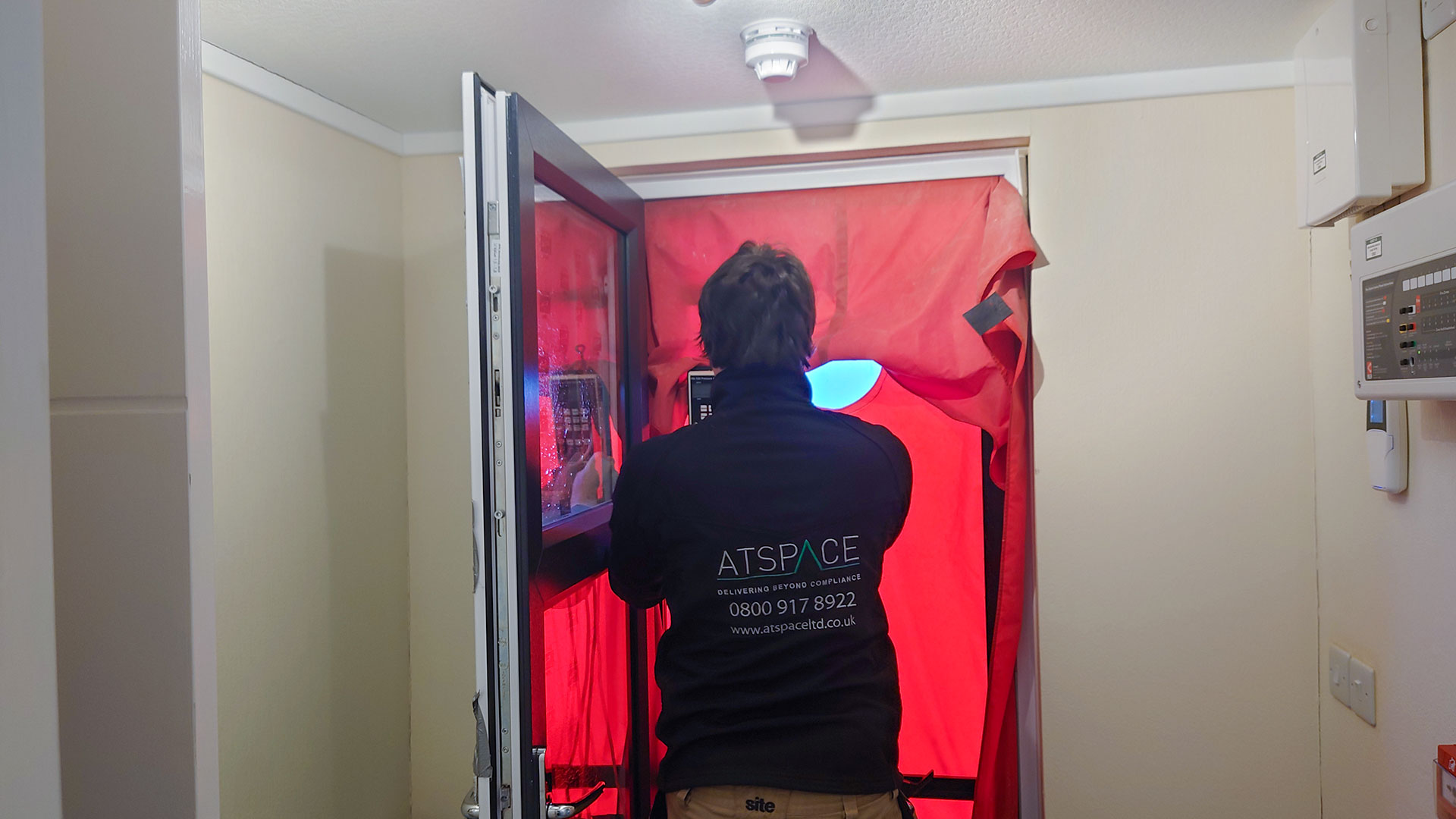
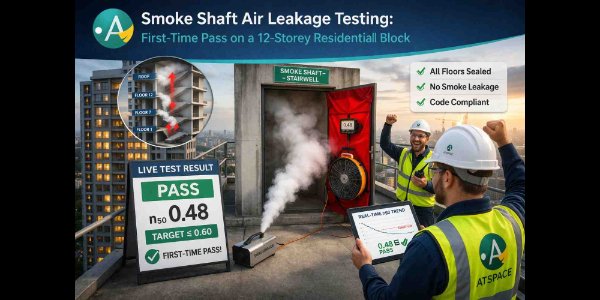
The engineer sets up a fan arrangement to seal and pressurise or depressurise the shaft, measures the airflow needed to maintain the test pressure, and calculates the leakage rate against the shaft area. If the result is close or the shaft fails, smoke and sometimes thermal imaging are then used to show the site team where the leakage paths actually are.
It depends on shaft size, height, access and whether diagnostics are needed. Published guidance from testing providers suggests a smaller single shaft may take around 1 to 2 hours, while larger buildings or multiple shafts often take 2 to 4 hours or more, and full site attendance is commonly longer once setup and investigation are included.
Cost is mainly driven by building height, number of shafts, size and complexity of each shaft, access, and whether the test has to be done out of hours or with diagnostics. That is why a quick single-shaft visit is a different price from a high-rise scheme with multiple shafts, live-site constraints and remedial support built in.
Have the shaft drawings, target leakage rate, build stage, access details and any temporary sealing plan ready before booking. Practical smoke shaft checklists also ask for the shaft envelope information up front because the leakage rate is calculated against area, so without drawings or dimensions the tester cannot price or report the job properly.
Make sure the shaft is complete, penetrations and fire-stopping are finished, debris is cleared, power is available, and the agreed openings are prepared in line with the test method. Published smoke shaft prep guides also note that all AOV doors should be shut and the top of the shaft temporarily sealed where the method requires it. That final readiness check is what protects first-time pass.
Most smoke shafts fail because the shaft was never truly airtight in the first place. Typical problems are unfinished builder’s work, poorly sealed AOV frames, unsealed joints, penetrations and awkward interfaces between trades. Smoke control designers work to strict leakage assumptions, so even small defects that look minor to a site team can be enough to blow the result.
The common leakage points are usually junctions, joints, frames and architraves around AOV openings, cable penetrations, conduits and other service interfaces. Several specialist testing sources also flag the shaft head, base and access door interfaces as repeat offenders. These are exactly the details that cause pain at handover if nobody checks them early.
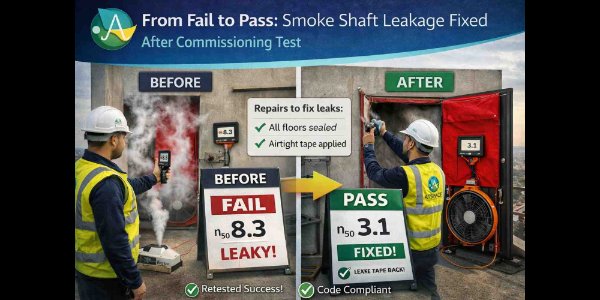
If it fails, the leakage paths have to be found, sealed and retested before the shaft can be relied on for smoke-control acceptance. In practical terms that usually means delayed commissioning, more visits, more trade coordination and a risk to handover. The earlier you diagnose the failure, the cheaper it is to recover.
Yes. Smoke testing is one of the quickest ways to show where the shaft is leaking, and thermal imaging can support the diagnosis where conditions allow. Providers specialising in smoke shafts use both methods to locate leakage paths and guide remedial works, which is far more efficient than sealing blindly and hoping the retest improves.
Pass first time by treating the shaft as a specialist work package, not a generic riser. Confirm the target early, build the shaft to the correct material and fire-separation standard, seal AOV frames and penetrations properly, and test the builder’s work shaft before the smoke-control kit goes in. Sites that leave it to the last week usually create their own rework.
Yes, that is the current direction of the guidance. Approved Document B says smoke shafts in the common escape route arrangement should be constructed from Class A1 material, and the SCA’s 2024 statement says smoke shaft and duct materials should be Class A1 reaction to fire as a minimum. This is not a detail to leave vague in the spec.
Only if the exact system has the right smoke-shaft test evidence. The current SCA position is that smoke shaft materials should be tested to BS EN 1366-8 and classified to BS EN 13501-4, and CIBSE Journal reported that British Gypsum said certain shaft systems were not tested to BS EN 1366-8 or BS EN 12101-3, so no performance claims to those standards could be made. In short, fire resistance alone is not enough.
Yes. Current SCA guidance says a builder’s work smoke shaft should be smooth internally. That matters because rough, irregular or incomplete internal surfaces make leakage harder to control and can undermine both air tightness and clean commissioning. It is a simple requirement that still gets missed on live sites.
No, they should not. The SCA guide says the smoke shaft should only contain equipment directly associated with the smoke ventilation system and that no other building services should be contained within the shaft. The same principle appears in Approved Document B for firefighting shafts. If unrelated services go in, expect trouble later.
A natural smoke shaft relies on natural buoyancy and opening vents, while a mechanical smoke shaft uses powered extract fans and controls to move smoke. The purpose is the same: protect escape routes by clearing smoke from lobbies or corridors. The big differences are how performance is achieved, how much space the system needs, and how the design is validated.
If you are following BS 9991:2024, yes. The standard now recommends that buildings above 18m use natural or mechanical smoke shafts, and direct-to-outside AOVs are no longer the recommended route for those residential situations. That is a meaningful design change, so it needs to be picked up early, not at technical submittal stage.
Under BS 9991:2024, yes for protection of stair lobbies. The updated standard says that above 30m only mechanical smoke shafts should be used, either extraction or pressurisation, and natural smoke shafts are no longer acceptable for that residential application. That change has obvious implications for shaft design, leakage control and commissioning.
Yes, under BS 9991:2024 they do. Cundall’s summary of the updated standard notes that for buildings more than 60m high, a mechanical smoke extract system needs to be designed to the principles in BS EN 12101-13, specifically Annex D. On these projects, smoke shaft testing is even less of a “nice to have” and more of a validation step in a complex engineered system.
No. Residential apartment buildings are the most common use case, but the SCA also notes that smoke shafts and smoke control ducts are used in other multi-level buildings, particularly where a firefighting shaft is needed. So while the residential market drives most search intent, the service is not limited to flats alone.
Yes. The SCA’s common escape route guidance is explicitly written for apartment buildings and says the same principles can be used for owner-occupied housing, social housing, assisted living, and apartments for short-term rental, including student apartments and apart-hotels, where they are designed and built to the same principles.
Yes, where the fire strategy requires that approach. The SCA notes smoke shafts are used in other multi-level buildings taller than 18m requiring a firefighting shaft, and Approved Document B Volume 2 requires firefighting shafts to have means of venting smoke and heat. Mixed-use schemes just need the boundaries and strategy agreed properly from the outset.
A smoke shaft is the duct or riser that carries smoke to outside, while a firefighting shaft is the protected stair, lobby and often firefighting lift arrangement used by the fire and rescue service. They are related but not the same thing. A firefighting shaft needs smoke venting, and a smoke shaft may form part of how that venting is achieved.
Yes. For natural smoke shafts, Approved Document B sets out minimum geometric criteria such as 1.5m² shaft area and 1m² free-area vents, and testing checklists also require drawings because the leakage rate depends on the shaft envelope area. If the shaft dimensions are unclear or the geometry changes late, the testing and the smoke-control design both become harder to trust.
Yes, they can. Smoke shaft specialists regularly point out that the accepted leakage target is demanding, and on a small shaft even relatively minor gaps can have a big effect on the result. That is why “it’s only a small shaft” is not a sensible site assumption. Smaller does not mean easier if the detailing is poor.
Yes. The SCA warns that increased leakage and pressure drop can drive the need for larger fans and higher negative pressures, and smoke-control manufacturers also note that keeping shaft leakage within the accepted limit helps the design extract rates be achieved without oversizing the system. A leaky shaft is not just a paperwork problem; it changes how the system performs.
Not by itself. The leakage test focuses on the shaft envelope, while the wider smoke-control commissioning process also has to prove system operation, cause-and-effect and, for mechanical systems, extract rates. SCA guidance is clear that BS 7346-8 governs commissioning and acceptance testing, and that extract rates on mechanical systems should also be proven.
No. It is one critical part of smoke-control verification, but it does not replace full commissioning. BS 7346-8 is the recognised code of practice for commissioning and acceptance testing, and SCA guidance treats testing of the smoke control system against the design criteria as a broader process than just measuring shaft leakage.
The SCA’s current statement lists the main component standards as BS EN 12101-2 for natural smoke and heat exhaust ventilators, BS EN 12101-3 for powered smoke and heat exhaust ventilators, BS EN 12101-7 for smoke control ducts, BS EN 12101-8 for smoke control dampers, and BS EN 12101-10 for power supplies. That list is useful because smoke shaft problems are rarely only about the shaft.
Yes. Smoke shaft testing is carried out on both new and existing buildings where there is a need to verify performance, investigate defects or support compliance. On occupied buildings the challenge is usually logistics rather than principle: access, smoke-control coordination, resident or FM liaison, and sometimes out-of-hours working.
After handover, the smoke-control system needs routine testing and maintenance, not just a one-off memory of the construction test. Industry guidance tied to BS 7346-8, BS 9999 and the BS EN 12101 family points to weekly and monthly checks with annual competent-person servicing, and more detailed periodic testing depending on the system. A fresh shaft leakage test is sensible after major alterations, damage or repeated faults.
Yes, and on live residential or mixed-use sites it often makes sense. Publicly available pricing guidance for smoke shaft testing already treats out-of-hours working as a normal factor because access, resident impact and smoke-control system isolation can be easier to manage outside core building use. It is usually better to plan that early than improvise it late.
You should get a clear air leakage report showing the measured leakage result, the shaft tested, the benchmark used and the outcome, plus any diagnostic findings if leaks were found. BS 7346-8 commissioning practice includes certification examples, and several smoke shaft specialists also provide a test certificate or compliance report for the handover pack. If the result is vague, expect problems later.
Choose a specialist who understands smoke control, not just generic building air tests. SCA guidance recommends competent organisations with appropriate smoke-control expertise, and broader industry competency work stresses that competent people are needed at design, installation, commissioning and handover stages. In simple terms, pick a team that can work with the fire engineer, smoke control contractor and Building Control without guessing.
Yes. The SCA’s 2024 statement tells designers to consider the material being used for shaft construction because some common constructions provide fire resistance but are not suitable for the leakage, insulation and pressure demands of a smoke shaft. BS 9991:2024 also pushes specialist smoke-vent input earlier on taller buildings. That early coordination is what reduces costly rework later.
Treat the shaft as a handover-critical package from day one. Confirm the leakage target early, test the builder’s work shaft before dampers and fans go in, make sure penetrations and AOV frames are properly sealed, and do not wait until final commissioning to discover the shaft leaks. The projects that keep programme intact are the ones that validate the shaft early, not the ones that hope it will be fine.
Videos for smoke shaft air leakage testing
Explore our videos for quick, engaging insights on building compliance. From step-by-step guides to expert advice, our video library simplifies complex topics, making it easier for you to take action and stay informed. Perfect for when you need clarity in minutes!